Only three weeks out from the from the next Riyadh Season show in Saudi Arabia and, with another announced yesterday for February 22 containing big match-ups, the heavyweights are in vogue.
But, will we be any closer to confirming the dominant heavyweight of this era ?
Each decade has been typified by almost mutual acceptance and agreement of the dominant heavyweight. Think Joe Louis in the 1940s, Marciano 1950s, Ali ’60s & ’70s, Tyson 1980s, Holyfield ’90s and Lennox Lewis early 2000s. True, arguements can be made for Joe Frazier and Larry Holmes for instance, then Wladimir Klitschko into the new millennium, but generally, it was settled in defining fights. Will December 21 in Riyadh settle it for good ?
Usyk or Fury ?
Somehow we don’t think so.
Oleksandr Usyk may stake his claim with an emphatic second victory over the ‘Gypsy King’, but he will always be considered a cruiserweight who bulked up to join the big boys, and, as is rumoured, might even return to the 200lb division.
A number of heavyweights are circling around the ‘top dog’ and will all be showcased over the coming months. Current IBF champion Daniel Dubois will face former WBO champion Joseph Parker, leading WBC contender Zhilei Zhang will face German Agit Kabayel in an official eliminator for the title. Add into the mix promising heavyweights Martin Bakole and youngster Moses Itauma. It looks an exciting time with some movement in the top ten. However, the dominant champion should be determined on December 21, but likely with another rematch clause or trilogy fight if Tyson Fury emerges victorious.
This would still leave our leading question unanswered. Usyk, Fury…even Joshua and Wilder should they make successful comebacks. From the young breed Itauma maybe ? We’re still struggling to find that 2020’s king and the next few months will hopefully get us closer to the answer.
The gloves that Floyd Mayweather wore when he beat Manny Pacquiao are among the most desired collectables in sport.
But they are already unaffordable, and will be for many years, to all but a few extremely wealthy collectors.
Boxing fanatics all over the world rushed to obtain T-shirts, miniature gloves and other items that were produced and sold before and after the welterweight title bout in May 2015 in Las Vegas.
The memorabilia contributed to the staggering revenue generated by “the fight of the century” but their value will probably not increase substantially over the next few years.
However, the shorts, the boots and the gloves the boxers wore will be worth a fortune as long as boxing remains a popular sport that triggers hard-to-explain emotions and passion.
Gloves and clothing that Muhammad Ali, Rocky Marciano and other famous champions wore for some of the most memorable fights in history are now worth as much as coveted baseball and soccer items, if not more.
Among the most passionate boxing enthusiasts are collectors who usually regard it as a hobby, but to whom it can become an obsession.
Many South Africans own and treasure autographs, signed photographs, old books, gloves and items of clothing that their heroes wore in the ring. But only a few became long-time collectors of note.
One of the earliest serious collectors of boxing memorabilia in South Africa was Charles Zastron, a tram driver from Malvern in Johannesburg.
Not much is known about the whereabouts of whatever he had in his humble home but it was said to be of substantial value.
The Chris Lessing Museum
Chris Lessing, a Johannesburg advocate, had a collection that visitors from abroad described as one of the most complete in the world.
Lessing kept his items at his house in Alberton and after his death in 1978 everything was donated to the SA Boxing Board of Control for the establishment of the Chris Lessing Museum.
The museum was set up in the board’s offices in the Fattis and Monis building in Loveday Street, Johannesburg.
When the board moved to Nasrec, south of Johannesburg, Lessing’s collection could be viewed there, but since the move to the present offices in Midrand the items have reputedly been kept in storage.
After Lessing’s death, Helgard Muller of Pietersburg became South Africa’s leading collector of boxing memorabilia. His library of 16mm films of historic fights, international and South African, was regarded as the most comprehensive in the country.
Most SA collectors tend to specialise but others spread their wings and acquire a wide range of items; almost anything relating to boxing. Houlton Andrew, who lived at Sabie in Mpumalanga before he emigrated to England, was one of those who had an amazing range of collectables.
Chris Greyvensteyn
Chris Greyvenstein, who wrote The Fighters, a collectable book in itself, and Karel de Vries, collected mostly historical items. Both lived in Cape Town.
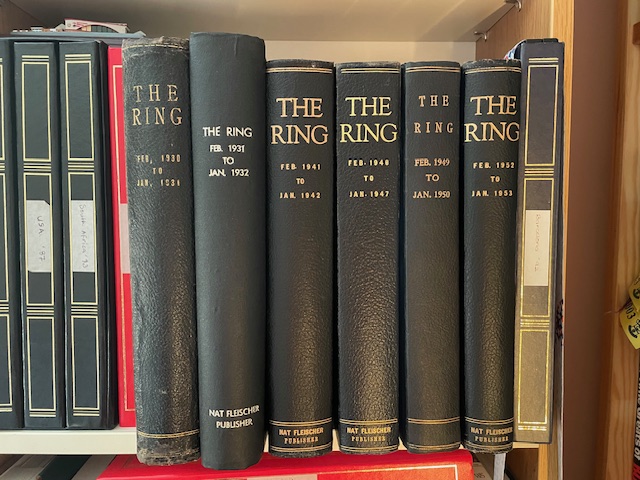
De Vries, for instance, had a complete collection of copies of Ring magazine, dating back to February 1922. At the time, Muller was the only other South African who had a complete set of the magazine’s issues.
After Greyvenstein and De Vries had passed away, their collections were sold for well below their value because there were so few avid local collectors with the money and space to take over everything and it would have cost too much to send the items overseas.
In the late 1980s Alfie Andrade established a collectors’ club in Cape Town. Meetings were well attended for a few years but the interested waned until the club ceased to exist.
Danny de Villiers, a professional referee who also lived in Cape Town, was another with an excellent collection that was eventually sold.
Jeff Ellis And Andre De Vries
Eric Moolman, in his time one of the leading SA referees, owned one of the finest collections of boxing photographs in the world.
When he was a youngster, Moolman wrote to boxers all over the world, asking for their autographs and photos. He later sold his books and photographs to Jeff Ellis, a well-known promoter who is now one of the few serious boxing collectors in South Africa.
Another one is Andre de Vries from Pretoria. He also specialises in keeping records of SA boxers and has thousands of entries in his files.
Ellis, who has a particular interest in tournament programmes, also has more than 40 000 photographs in his collection.
I have collected hundreds of boxing books since 1947 when I received one shilling as pocket money per week.
At that time, Butch Burman’s Book Store at 12 Wanderers Street in Johannesburg, advertised a copy of Joe Louis – A Picture Story of his Life. It was written by Neil Scott and cost seven shillings and six pence; which came to 75 cents.
I went without sweets for about ten weeks and also did not buy the magazine Champion during that time to save enough money to take a train from Germiston to Johannesburg and to buy the book.
After a long chat with Burman, who became a friendly and efficient supplier of books to me for many years, I went home, little knowing that collecting boxing books and other items to do with the sport would become a lifelong passion.
Beyond The Reach
Many collectors of sports memorabilia run out of space at some time or another but in recent years, as a result of the drop in the rand’s value, the cost of acquiring items from abroad has become the main constraint for South Africans.
A bound volume of Ring magazines of the 1920s and 1930s would be beyond the reach of the average SA collector, stretching to tens of thousands of rand.
A bound volume of Boxing, now known as Boxing News, comprising the first 16 issues of the English publication and covering the period from September 11 1909 to December 24 1909, was advertised for $6 000, more than R75 700 at recent rates.
One of the scarcest boxing books, Black Prince Peter, by A G Hales published in 1910 and was sold for $2 995, which now converts to nearly R38 000.Relief to Royalty – James J Braddock, a book by Ludwig Shabazian, was offered for $320 (over R4 000).
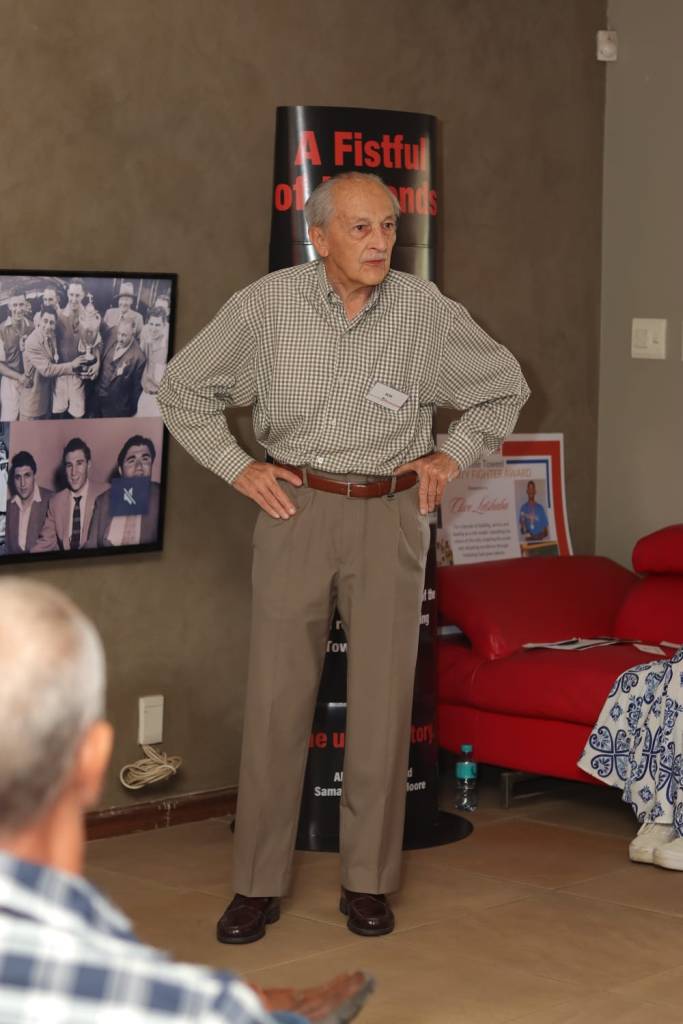
Boxing historian/writer Ron Jackson at the recent South African book launch on the legendary fighting Toweel family.
A Fistful of Legends
A global, inspirational father’s story of ‘Faith and Fight’ which helped his sons overcome many obstacles and write history, earning them a place in the Hall of Fame and transforming the history of a nation.
At long last a book has been published on the life of the fighting Toweel’s from Benoni, a suburb of Johannesburg, South Africa.
Alida Toweel the wife of the late Willie Toweel and his daughter Samantha has delved into many files and newspapers to put together a fine book relating to the trials and tribulations of the Toweel family.
In 1910, at age five, Mike Toweel, made his way to South Africa on a boat from Lebanon, with his widowed mother. Near blindness, caused by measles as well as their immense poverty, kept him out of the classroom. As an illiterate child he worked on the streets, selling bootlaces and faced many street fights triggered by xenophobia. This led him, as a teen, to find only one place to call home – the boxing ring.
Determined to obtain world class status he worked towards winning a gold medal at the 1924 Olympics. All seemed on track when he won the Transvaal Olympic trials and was awarded a gold medal by the Prince of Wales for his achievement. But his mother, desperate to raise upstanding, reputable children, who would be accepted as a credit to the country, barred his path and shattered his dream.
Devastated, Mike became a money-fighter. He married Dinah and the financial strain of seven children, one seriously disabled, eventually forced Mike away from the ring. But his most devastating blow came when Dinah died, after birthing their eighth child. Social services closed in to take his unruly, grieving children away from him. But, Mike would not let this happen as long as he had breath in his body. He built a simple structure in the backyard of their Benoni home from corrugated iron. In this Tin Shanty Gym, as it became known, he achieved the seemingly impossible.
He cultivated a passion for boxing in his six sons. His eldest, Jimmy took the professional ranks by storm seizing national titles and being headhunted as the country’s best international prospect. Each son, Viccie, Alan, Willie and Frazer, in hot pursuit, began to make headlines.
Mike was recognized as a noteworthy trainer when half of the fighters who represented South Africa in the 1948, London Olympic Games did so under his coaching. One was his own son, Victor. Another, George Hunter, who took the gold medal and won the prestigious Val Barker Trophy. In 1952, his other son, Willie, made history as the second Olympian from the same family, and won a bronze.
Victor, the 5’2” ‘Benoni Bomber’, walked out from his Tin Shanty Gym, into the ring with his gloves resting on Papa Mike’s shoulders and faced his 14th professional fight, a world title, set up by the one and only boxing body in the world. He was only 22 yet entered the ring with two national titles under his belt and a Commonwealth Title to boot.
That night, 31st May 1950, he wrote history, as he won the first world title South Africa ever held and turned the sporting eyes of the world onto South Africa and the British Empire. This ignited hope and passion for the sport, which flowed into neighboring countries and across the British Empire. As world champion he gave the Lebanese acceptance as South Africans. They were no longer referred to as ‘Dirty Syrians’ and ‘Donderse Uitlanders’.
As obstacles mounted before him, Victor remained determined to help grow the nation. He made immense sacrifices and endured inhumane struggles. After years of overcoming, he could no more.
When Willie saw his brother fall, he jumped into the ring and challenged the world champion, to fight him, so he could reclaim the title for his family and the nation.
Willie, who was known for being a man of his word, took 20 impressive victories, most within the distance. These included 4 prestigious South African titles as well as the British Empire title. He was given a shocking decision of a draw when he fought for the world title. Three fights later tragedy struck. He knocked out an opponent who died 52 hours later.
According to his opponent’s trainer, who spoke at the inquest, the fighter had had a history of health problems and was experiencing blackouts in training. Willie’s ‘knock-out punch’ had simply grazed his cheekbone. Nevertheless, the country turned their backs on the 21 year old, whom they victimized as a killer.
Mike, seeing this, teamed up three of his sons and sent them to Britain to escape this nightmare and find their way to bring South Africa a second world title. Willie as the fighter, Alan as the trainer and wheelchair bound Maurice as his manager.
Willie was lauded for his classic boxing approach and became widely acclaimed in Britain as well as America. His fights were used as teaching material across schools in Britain. Never before had they witnessed such a clean fighter who had mastered all aspects of the ring.
Willie’s exceptional career progressed but it was evident that he was haunted by the death as he held back his knockout punch. Neither hypnosis, nor counsel of psychologists or psychiatrists, could stem his fear of seeing another boxer die. Willie would not give up his chance to give a voice to the voiceless. So, he wrestled his terror every time he entered the ring, keeping his eyes on the greater purpose. He drew on his faith to find peace, and rose against all odds to help the youth to learn, that greatness and leading change doesn’t require perfection, it requires courage to fight on.
Thanks to Ron Jackson for highlighting this and the above article.
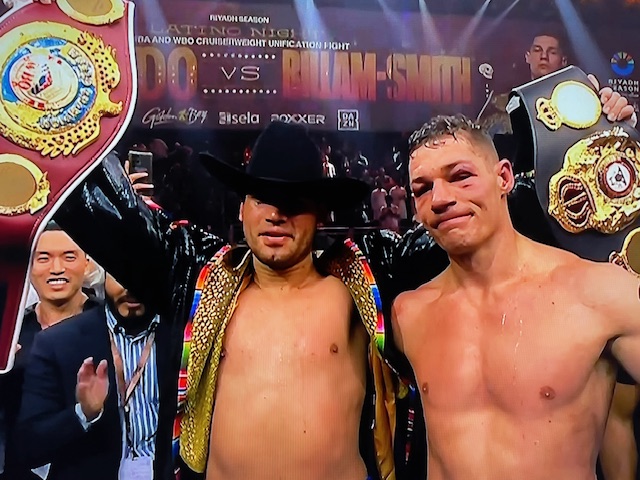
Testimony of a tough fight. ‘Zurdo’ Ramirez (in robe) and Chris Billam-Smith show mutual respect.
The co-main event of ‘Latino Night’ in Riyadh, Saudi Arabia on Saturday resulted in two-divisional ‘world’ champion Gilberto ‘Zurdo’ Ramirez unifying two world title belts in the cruiserweight (200lbs/14st, 4lb) division.
It was a gruelling twelve-round fight that showed the toughness of both combatants and forced them to answer many of the questions that the sport asks. How much do you want it ? Are you skillful enough to beat this man ? Can you take a punch ? and, Are you in condition to last the stretch and ultimately be victorious ?
Zurdo certainly answered all those in the affirmative. The defeated Chris Billam-Smith answered many of these too, with the exception of the latter.
Pre-fight, Ramirez brought the WBA belt into the ring and Billam-Smith the WBO. Only one man could leave with both.
It was an excellent contest, that although devoid of knockdowns or cuts drama, was interesting and entertaining throughout. The WBO champion from Bournemouth, England took the opening round on accuracy and workrate, and it looked like his bigger frame, being a natural and career campaigning cruiserweight, might be the difference over the course.
From the second round on, the WBA champion from Mexico gradually took control out of his southpaw stance peppering Billam-Smith’s body and landing heavy head shots off the jab. The English ‘Gentleman’ although cut from the fourth round was troubled, but his corner were excellent in stemming the flow of blood so that it didn’t become a defining issue.
Billam-Smith showed the grit to come through anything that Ramirez was able to land on him and, although clearly fatigued in the championship rounds (10-12), he lasted the course.
He had his moments over the duration of the contest but was resoundly beaten with the judges cards returning 116-112 twice and 116-113 on the third, all in the Mexican’s favour.
Ramirez record rises to 47-1 (30 KOs) and Billam-Smith fell to 20-2 (13 KOs). The latter is now 34 and will have to regroup, but it will be difficult with a young family. His desire will be tested. ‘Zurdo’ goes onto bigger challenges, only having a sole loss on his record against elite light-heavyweight Dmitry Bivol.
Throughout the fight week build-up both boxers had shown real class and this continued at the end of Saturday’s contest with both acknowledging each other’s toughness. It was a credit to the sport and contrasted sharply with the ‘bore-fest’ held in Arlington, Texas the night before.
The only thing there we wish to note is that former undisputed world heavyweight champion Mike Tyson dropped his record to 50-7 (44 KOs) in losing to YouTuber and current boxer Jake Paul who recorded his eleventh win. It is understood that both fighters made a lot of money in the process.
In the women’s code, Irish Olympic gold medallist Katie Taylor recorded a close rematch victory over Amanda Serrano to retain her undisputed world light-welterweight title on the Texas show. It was reputedly as riveting as their first encounter in Madison Square Garden, New York City two years earlier. Taylor, now 38, and a future female boxing hall-of-famer, has maybe one more big contest in her. It will be her call, but she continues to win for now.
This regular feature is to also raise awareness of the Ringside Charitable Trust.
Welcome to a new regular feature to hopefully retain and feed your boxing interest over the quieter mid-weeks.
Slick Tokyo Olympian, Keyshawn Davis (on left), continues to impress. Photo: Mikey Williams/Top Rank
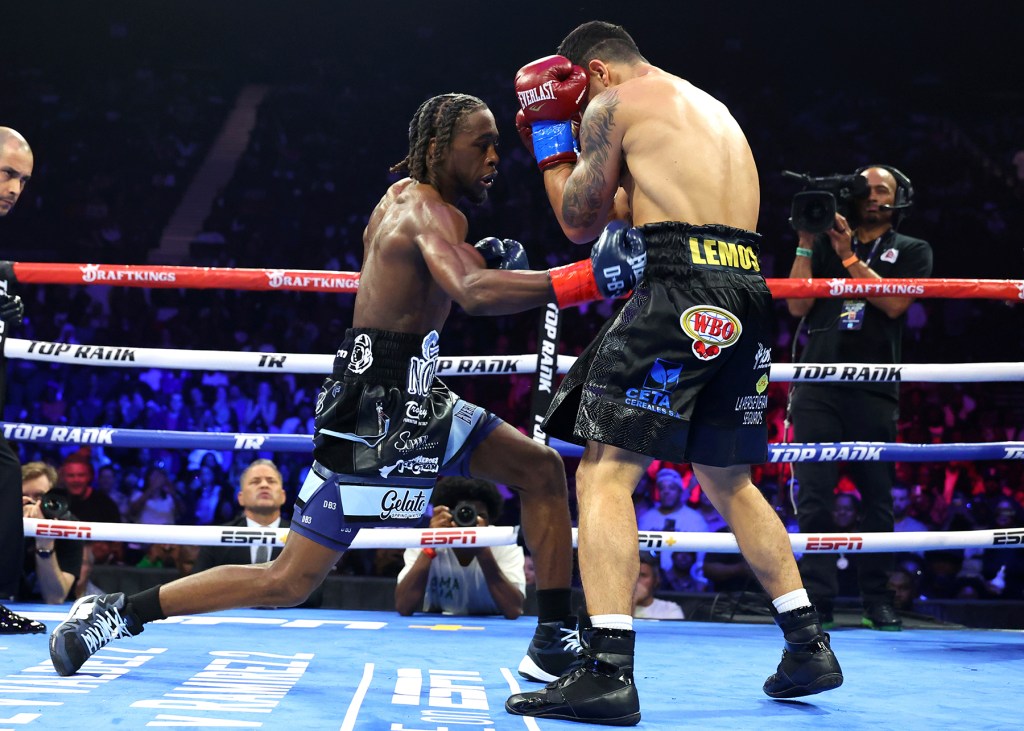
Best action of last weekend was the standout victory by American lightweight contender Keyshawn Davis. The Tokyo 2020 silver medallist registered an emphatic two-round stoppage over up-til then, tough Argentinian Gustavo Lemos.
Davis (now 12-0, 8 KOs) shone in front of a 10,568 home crowd in the Scope Arena, Norfolk, Virginia, USA, famous for being the home of hall-of-famer and multi-weight world champion Pernell Whitaker. If he can match ‘Sweet Pea’s’ accomplishments we’re in for some ride !
Saturday night (Nov 8) Davis was sensational, knocking Lemos down three times in the second round en-route to the inevitable stoppage. The fight ended with a brutal left hook/strong right combination.
Pre-fight Lemos (29-2, 19 KOs) came in significantly heavier, failing to make the stipulated weight by over six pounds. He was cited as being up to 20 pounds heavier than Davis come first bell. Despite this, the home fighter went through with the fight, not wishing to disappoint his vocal and rising fanbase. This made his mindset and the manner of his victory even more impressive.
Davis continues to march through the 135 pounders (9st, 9lbs) and his likeable charisma makes him a potential big star in the sport. Think Sugar Ray Leonard with a smile to match.
By now, no surprise to hardcore followers of the sport, Davis is promoted by Bob Arum’s Top Rank Inc. and should get the backing and fights necessary to reach his goal. He sits in probably the deepest division in boxing but there are some great matches out there. Watch out Gervonta Davis, Vasiliy Lomachenko, Shakur Stevenson et al.
The soul-diva Aretha Frankin sang about having “a little”.
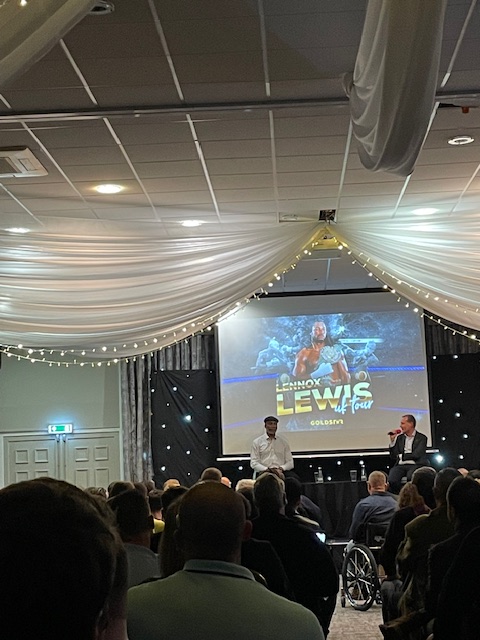
Three-time and twice lineal world heavyweight champion Lennox Claudius Lewisdeserves it, and he definitely commands it. Those who continue to attend his British ‘meet and greet’ tour will listen attentively to his story and achievements and be impressed, as ever, with his class and humility. This is how champions and heroes should be.
His achievements are considerable;
Prior to May 2024 and the crowning of Ukrainian boxer Oleksandr Usyk, Lewis was the last undisputed heavyweight champion. That barren period dated back to November 1999 when Lennox defeated former co-three-time champion Evander Holyfield after a controversial draw in their first meeting in March of that year. Lewis should have rightly been awarded the title then.
The rematch decision victory finally capped a boxing career that saw him originally climb the mountain in the amateur code by competing in two Olympic Games (Los Angeles 1984 and Seoul 1988), winning super-heavyweight gold in the latter.
Moving onto the professional ranks in June 1989, basing himself in the UK and defeating Al Malcolm, he gathered the British, Commonwealth and European titles inside two years, capped by a stoppage of dual champion Gary Mason.
Lennox went on to compile a career record of 41-2-1 (32 KOs) and amassed this with notable victories over Holyfield, Mike Tyson and a string of young contenders. His two defeats against Oliver McCall and Hasim Rahman were both avenged in emphatic fashion.
When I first saw him address an audience in 2018, an attendee – ‘Prince’ Naseem Hamed, himself a notable world champion at in a much lower weight class, referred to Lewis as “The King”. Their careers crossed during the peak years for both, and they jointly flew the Union flag across the boxing world, particularly the USA.
Lewis was one of the great heavyweights at the turn of the 21st century and is considered as the greatest born in the UK (that being West Ham in east London) and, although he emigrated at a young age and competed for Canada in the Olympics, is widely regarded by boxing fans as an ‘honorary’ Brit. He in fact has dual-nationality.
His accomplishments far outweigh any discussion on his naturalisation. He will go down as one of the great heavyweights and it’s a continuing debate on his place in the top ten greatest of all time. If not within it, he’s in the mix. He famously referred to being the only man standing when he entered a room with the fellow tough men (heavyweights) of his era. This he certainly was.
Last night in Maidstone, England, Lennox held court and captivated an audience with his career tales. He was lucid and sprightly enough to demonstrate the footwork and straight jab that provided the foundation for the success of his career. he also paid homage to major influences and mentors like famed trainer/Kronk gym founder Emanuel Steward and some of his illustrious battles in the ring.
His Goldstar tour continues in the UK, catch it while you can.
In a week marking the 50th anniversary of the iconic ‘Rumble in the Jungle’ held in former Zaire, Central Africa when ‘The Greatest’ Muhammad Ali captured the World Heavyweight title for, a then record third time, we post another article by esteemed South African boxing writer and historian Ron Jackson.
My connection with Muhammad Ali
The first time I read about Muhammad Ali then known as Cassius Clay, was in 1960 after he won an Olympic gold medal at the Rome Olympics, and as a young 19-year-old upstart walked around the Olympic village with the medal around his neck claiming that he was greatest.
Many years later in an autobiography Ali claimed that shortly after his return from the Olympics he threw the Olympic medal into the Ohio River after he and a friend were refused service at a “whites-only” restaurant.
However, this has been disputed by some of his close friends and it has been reported that he lost the medal, which was replaced and presented to him at the 1996 Olympics in Atlanta, when in a much publicised event he lit the torch to begin the Games.
The insult of not being allowed into the restaurant was possibly the start of his stand against injustices to his race and he spent a lifetime standing up for his beliefs, whatever the consequences.
As the South African government only allowed the introduction of television into the country in 1976 we were denied watching the Olympics and most of the fights of Ali’s professional career live; and had to rely on newspaper reports and video tapes of Ali’s fights and career.
Subsequently though video tapes and later DVD’s and the many books written about Ali I was able to continue my journey with the career and life of Ali.
There must be more than 50 books published on the career of Ali and I am privileged to have 50 in my collection, with possibly the most outstanding being His Life and Times by Thomas Hauser and the most controversial being Ghosts of Manila by Mark Kram.
However, there is one book that that is the best of them all and possibly one of the best sports books ever produced, and that is GOAT (A Tribute To Muhammad Ali – Greatest Of All Time) published in 2003 by Taschen in two limited editions.
The “Champs Edition” was limited to 1000 individually numbered copies, with each one signed by Muhammad Ali and sculptor Jeff Koons.
The book weighs 34 kilograms and comes with Koon’s Radical Champs sculpture and is packaged in a silk covered box, and bound in pink leather by the official bindery for the Vatican, and today would cost in the region of £9000 (R156 502), which is out of the reach of most collectors.
Subsequently Taschen published a revised, updated and smaller version which cost in the region R1200 and made it accessible for the average collector.
Including the revised edition of The Greatest of All Time, there are two other books special books in my collection.
The Cassius Clay Story by George Sullivan published in 1964 has become a real collectors piece and the other one Cassius Clay – A Biography by Jack Olsen published in 1967, is not as rare but nice to have in a collection.
Clay and Ali memorabilia and especially items signed by Cassius Clay have always been expensive and will now be out of reach to the ordinary collector since his death.
Ali is without a doubt the most written and spoken about sportsman in history and will never be forgotten.
For me it has been a privilege to enjoy the journey of Clay and subsequently Ali, through books and videos over the past 56 years.
Ali passed away on June 3, 2016 and on Friday June 10, one week after his passing Ali’s funeral took place in Louisville Kentucky, his place of birth and he was laid to rest in the Cave Hill Cemetery located at 701 Baxter Avenue.
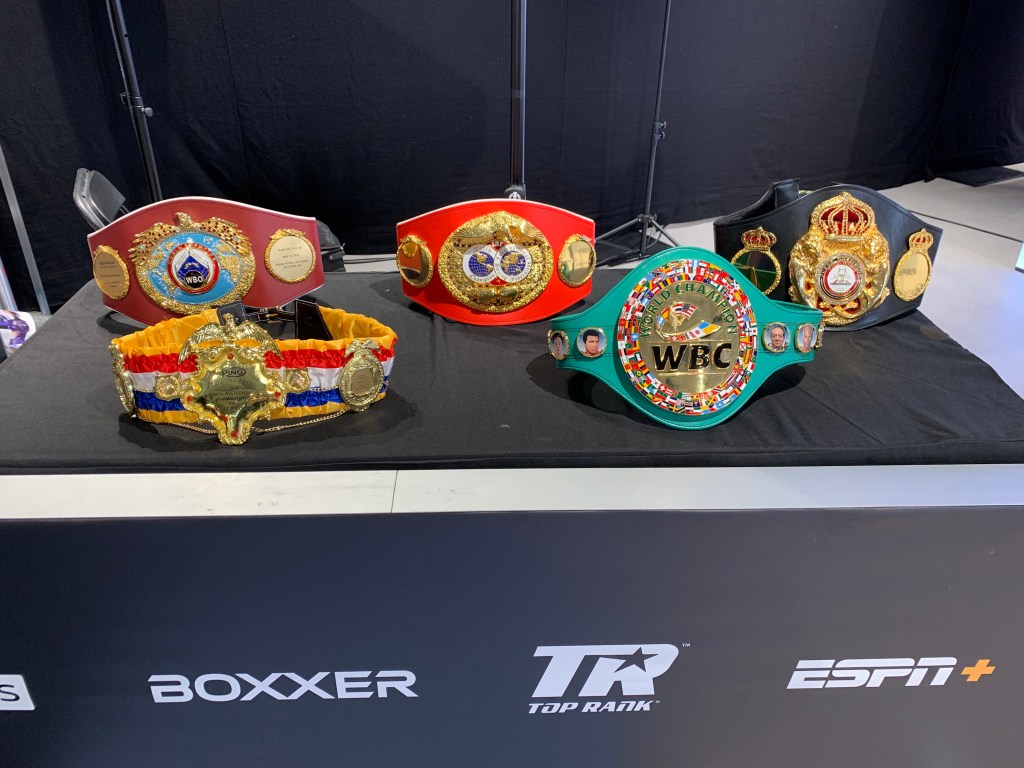
Boxing’s world belts – The Ring championship bottom left.
In July 1987 the then Editor-In-Chief of The Ring magazine Nigel Collins had finally seen enough of the proliferation of boxing weight classes and multiple sanctioning bodies. He penned a cover article titled A Return to Sanity and it was followed by affirmative action.
In it he decreed the magazine would return to only recognising the eight traditional weight classes, from flyweight through to heavyweight. He was supported by his colleagues and many of its readers and observers of the sport.
Over the following months they produced a photo gallery of what they considered to be the real champions.
These included only five champions of the eight classes (divisions) who were considered legitimate and in today’s climate deemed undisputed. One irony was that Michael Spinks at the time was recognised as The Ring heavyweight king even though Mike Tyson was the WBC champion and spectacularly taking all the headlines and plaudits. They were yet to meet.
Tyson’s victory in June 1988 in Atlantic City Convention Centre, bankrolled by then businessman and current US presidential candidate Donald Trump, was ultimately emphatic in a 91 second blowout of Spinks. Tyson was promptly crowned undisputed and The Ring champion.
The other divisional kings and that publication’s champions were ‘Marvelous’ Marvin Hagler at middleweight (160lbs/11st 6lbs), Lloyd Honeyghan at welterweight (147lbs/10st 7lbs), Antonio Esparragoza at featherweight (126lbs/9st) and Sot Chitalada at flyweight (112lbs/8st). The other four weight divisions had a #1 stated but The Ring title was declared vacant.
Project forward to today.
The Ring recognises 17 weight classes. Of those for the first time for many years – probably since 1987 – seven are undisputed and have a champion. The heaviest four weight classes from heavyweight (no limit) to super middleweight (168lbs/12st) all have a champion. This is a good sign for both hardcore and casual fans alike.
Even elite junior middleweight Terence Crawford, a four-weight beltholder/world champion, arguably the pound-for-pound #1 is not a Ring magazine champion at 154lbs. That’s how hard it is to get that honour !
Crawford has an impressive record of 41-0 (31 KOs) and is still looking unbeatable.
The respective records of The Ring champions are:
Oleksandr Usyk (22-0, 14 KOs) – heavyweight
Jai Opetaia (26-0, 20 KOs) – cruiserweight (200lbs/14st 4lbs)
Artur Beterbiev (21-0, 20 KOs) – light heavyweight
Saul ‘Canelo’ Alvarez (62-2-2, 39 KOs) – super middleweight
Other Ring Magazine pound-for-pound entrants include Dmitry Bivol, Gervonta ‘Tank’ Davis, Junto Nakatani and Devin Haney, who have a combined record of 133 wins with only 1 loss. Non however, currently hold the magazine’s title, which we consider remains the historical standard by which all world champions should ultimately be judged.
The seventeen weight divisions are another story, but they primarily serve to protect the fighters.
In today’s era of bigger human beings: with improved diets and many nourishment choices, it’s healthy to have a higher number of weight classes, with the differentials at lower limits more significant where % of total body weight is a crucial factor.
At the other end of the spectrum, no longer is a light heavyweight having to make the jump straight to an unlimited class. That would now be too dangerous, due simply to evolution of the human race.
To conclude, let’s celebrate the undisputed Ring Magazine champions but, the proliferation of weight classes are here to stay.
Artur Beterbiev celebrates becoming the world light-heavyweight king supreme.
At the end of the night and fight that mattered, Artur was simply better.
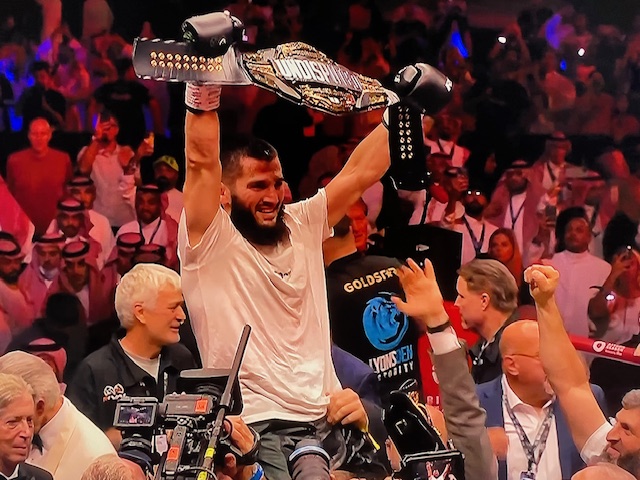
Some will argue ‘not’, some will say ‘just’, but we firmly believe the incoming WBC, IBF and WBO champion Artur Beterbiev won the fight and proved his superiority on the night.
Beterbiev raised his impressive record to 21-0 (20 KOs) and the incoming WBA champion Dmitry Bivol suffered his first defeat in his 24th fight at the Kingdom Arena, Riyadh, Saudi Arabia.
We promised you a fight of the year contender, and that’s just what we got !
Not your all-out slugfest with multiple knockdowns or one fighter coming back from the brink to prevail, but rather a technical and power-punching masterclass between two elite operators. It was ‘boxing chess’ but with seriously bad intentions.
The 36 minutes of action will live long in the memory and the resulting exchanges and outcome are crying out for an immediate rematch.
That will take some pulling together, but Saudi money and the will of the boxing hierarchy and powerbrokers will make it happen.
We made Beterbiev a clear winner, albeit by two-three rounds. We were closer to the third returned card of 116-112 that top trainer and boxing expert Teddy Atlas referred to as “absurd”. We couldn’t see that, but value and accept his judgement and rationale.
Other returned cards from the judges were a 114-114 draw and 115-113 in favour of Beterbiev, making the victory to him on a majority decision.
Like Atlas we gave the new undisputed champion the last two ‘championship’ rounds to secure the victory. We did though have him ahead going into those, witnessing him landing the heavier blows with the greater impact, controlling the pace of the fight from ring centre and being the more aggressive and accurate fighter throughout.
We knew that Bivol would attempt to control the tempo of the contest from the outside of the ring. This, he did at times, but although many, were fewer in the moments that mattered.
The 33 year old man from St. Petersburg was effective when he landed his heavy blows on the end of his long jab. He took the opening two rounds by imposing his game-plan immediately, but once Beterbiev worked his way into the fight he controlled its tempo and eventual outcome.
In our view Bivol just didn’t land as consistently and repetitively the heavy shots that Beterbiev did.
Neither fighter was rocked or over-troubled by the sorties that followed some of the most outstanding technical boxing you will witness.
Bivol’s greatest accomplishment was ensuring that in making the fight extremely competitive, he heard the final bell and halted Beterbiev’s up ’til then perfect KO record. This was rarely in doubt.
The 39 years of Beterbiev and his miniscus injury never became an issue as he lasted the hectic pace throughout.
The now undisputed world light-heavyweight champion, forever humble said post-fight “I feel not bad. I did not good today. I wanted to box today with more quality. I don’t know why, but I didn’t like this fight. But I’ll be better one day” He complimented Bivol’s grit, skills and effort, and finished .. “But today, Allah chose me”.
The defeated fighter was equally complimentary of his opponent and offered his congratulations and ended “He deserves it. No problem”.
Saturday was a credit to both fighters and the sport of boxing. It will also hopefully put to bed the flip-flopping of pronunciation of Artur’s surname. Me being one of the main culprits.
The bearded Dagestan Muslim was better and that should remove all doubt for the time being at least. Bivol goes on to fight another day with his reputation intact.
This Saturday (12 October) in Riyadh, Saudi Arabia the match-up of the boxing year takes place. Two undefeated Russians with excellent amateur pedigrees will meet to determine the undisputed world light-heavyweight (12st, 7lbs/175lbs) champion.
Artur Beterbiev (20-0, 20 KOs) will bring the WBC, IBF and WBO belts to the ring, and Dimitry Bivol (23-0, 11 KOs) the WBA one, ultimately giving us our first undisputed champion since Roy Jones Jr. in June 1999.
Before then, Michael Spinks (above) was the only previous dominant 175 pounder way back in 1983 when the division was arguably at its most ‘hot’. Unifications here are rare and undisputed even more so.
The division, one of the original eight weight classes, used to be full of elite fighters who weren’t quite big enough for the heavyweights, but had no option but to campaign at 175lbs. The rollcall of great champions includes Ezzard Charles, ‘Ageless’ Archie Moore, Bob Foster, Matthew Saad Muhammad, the younger Spinks brother and Roy Jones Jr.
This is a ‘blue riband’ boxing weight category.
So, what can we expect Saturday ?
Beterbiev, at 39, from the former Soviet province of Dagestan on the Chechnyan border in the south of the Russian land mass, is a destructive box-puncher. Having had a tough upbringing under the Soviet system, being a former world champion, winning silver in London 2012 (his second Olympics) only then losing to current heavyweight king Oleksandr Usyk, the bearded Beterbiev is ‘authentically tough’.
As a professional he has stand out victories against Britain’s Callum Johnson, Smith and Anthony Yarde, stopping them all inside the distance. He can be dropped, but he’s always done the stopping in the end !
He is an intimidating character inside the ring with a confident calmness outside of it. In boxing exile, fighting out of Montreal, Canada, he is excellently trained by Canadian Marc Ramsay, one of the best in the sport.
The fight was originally pencilled in for earlier in the year, but delayed by Beterbiev sustaining a number of injuries and having his knee reconstructed in the process. This could be a telling factor.
Bivol, 33, is of mixed Russian/Korean heritage from the province of Kyrgyzstan. He too had an excellent Soviet amateur schooling, but although younger, was not as decorated as his opponent. The tall orthodox fighter does though hold an undefeated record that includes he stellar name of Saul ‘Canelo’ Alvarez, one of the modern greats.
The WBA champion has been flawless since winning the title in 2017 making 12 successful defences, and his win over ‘Canelo’ in May 2022 finally elevated him into the ‘SuperFight’ category and won him The Ring magazine 2022 Fighter of the Year.
Bivol is an excellent boxer and the more stylish of the two. He tends to box at range and probe to victory before unleashing his heavy artillery. Beterbiev, by contrast is equally talented, but likes to get amongst it by smothering his opponent with his work rate and power punches. Fighting him is likened to fighting someone in a phone booth.
The big questions as we approach first bell are; 1) How much has the injury record and ‘Father Time’ affected Beterbiev ? 2) What does he have left as he approaches the final years of his career ? 3) Will the intense pressure he will undoubtedly put on Bivol be too much for the Korean/Soviet ? 4) Can Bivol command Beterbiev’s respect early on and box his way to victory ? 5) Can the IBF champion really take a punch and Beterbiev’s power ?
It’s an intriguing matchup and as we point to has everything to be the Fight of 2024.
It will be shown in the UK on various platforms as a pay-per-view/box office option and in the USA on ESPN+. It is supported by an excellent undercard featuring Ring Magazine and world unified cruiserweight champion Jai Opetaia, promising British light-heavyweight Ben Whittaker, and world ranked middle/super-middleweight Chris Eubank Jr. It also features the heavyweight rematch between Fabio Wardley and Frazer Clarke, plus female WBC champion and Aussie Skye Nicholson.
It forms part of the Kingdom of Saudi Arabia’s Riyadh Season and is multi-promoted, including Top Rank Inc. and British-based outfits Queensberry, BOXXER and Matchroom Boxing.
With much hesitation, in the main event we predict a Beterbiev stoppage win late on. Enjoy the fireworks !




 The Undisputed