Tokyo 2020 Olympic silver medalist Keyshawn Davis delivered an emphatic destruction of 2012 Olympian (and fellow silver medalist) Denys Berinchyk in the ‘small room’ at Madison Square Garden, New York City, Valentine’s night (14 Feb).
Although the Norfolk, Virginia fighter had been arriving over the last two years, this was his coming out performance, finally delivering on that early promise.
At only age 25 and arguably in the most star-studded and deepest division in boxing – lightweight (9st, 9lbs/135lbs)- with the frame to move through the divisions; the world is really the brash, talented and charismatic fighter’s oyster.
As earlier reported on these pages, shades or Sugar Ray Leonard or Pernell ‘Sweet Pea’ Whitaker are recasting over boxing.
Davis, now 13-0 (9 KOs), could be the second coming of either, although clearly having his own personality and style. An orthodox fighter with an outstanding amateur pedigree and Friday winning a first professional ‘world’ title with relative ease.
With an alleged racist grudge going into the fight the brave and tough Ukrainian lost his WBO title in his first defence, and with it his undefeated record.
Berinchyk, now 19-1, 9 KOs, was dropped by a Davis left hook in the third round and, taking further punishment, was finally stopped by a stunning right-left body combo on 1:45 of the fourth. The body shots were Davis’ route to victory hurting him throughout and, Davis also appeared to break the Ukrainian’s nose as blood heavily streamed out some time before the referee’s final stoppage.
Post-fight, ecstatic with his dominant showing and new ‘world’ title, Davis bragged “I want anybody who has the balls to step in the ring and fight me. There are two 135lb champions (likely referring to either Gervonta Davis or Shakur Stevenson as other champ Vasiliy Lomachenko is also a Top Rank Inc. fighter), that I would love to fight. If they have the guts to step in the ring with ‘The Businessman’, tell them to send me a contract, or I can send them one”. Promoted by Top Rank he’s in the right camp to make either of those two fights a reality, and then possibly move through the divisions.
In Manchester, UK Saturday night (15 Feb), a tough contest resulted in Britain’s Jack Catterall, now 30-2 (13 KOs), failing in his attempt to become the WBO mandatory contender at junior-welterweight (10st/140 lbs) losing by split decision (all cards each way 115-113) to Mexican-American Arnold Barboza Jr. (32-0, 11 KOs). It was a fight that was competitive throughout but never really caught fire.
The impressive Barboza, fighting in a hostile away environment, now moves onto world title contention. Catterall must regroup.
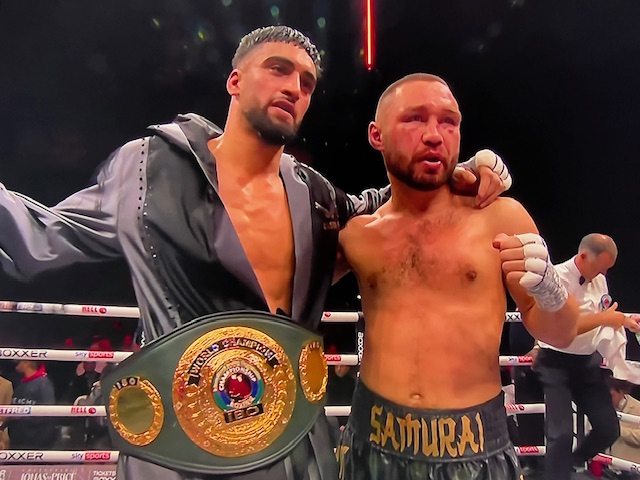
New IBO champion Adam Azim shares a final moment with Segey Lipinets.
Rising Briton Adam ‘Assassin’ Azim scored a major victory on Saturday (1 Feb) stopping former IBF champion Sergey Lipinets in the ninth round in a ‘crossroads’ fight, and importantly, secured a ‘crossover’ to world level.
With fellow Pakistani-heritage and former world champion’s Amir Khan sitting ringside, along with Shawn Porter from the US, it was a statement victory in good company.
The 22 year old Azim dominated the tough and always advancing Lipinets through the completed rounds with strong hooks, uppercuts and impressive body attacks.
Azim looked to win every round on skill, power and output, but was on a tightrope coming into the ninth as he was earlier penalised for repetitive low blows, being deducted a point in both the fourth and seventh by referee Steve Gray, and forcing Azim to share them.
Another low blow could have been catastrophic as the small, compact physique of Kazakh Lipinets caused Azim to stray low on numerous occasions.
What was impressive was the manner in which Azim controlled the tempo of the fight remaining composed (albeit with the help of cornerman Shane McGuigan) between rounds. This bodes well for his future steps up the world ladder.
Azim, fighting out of Slough, England clearly possesses the power to take out opponents with his record lifted to 13-0 (10 KOs). Lipinets durability and ring-savvy brought him to the ninth round, but he was dropped twice en-route. The finish in the end was inevitable when Steve Gray called a halt after a relentless spell of Azim pressure.
Lipinets’ record dips to 18-4-1 (13 KOs) but, although on the slide, on this performance he was brave throughout and although battered and bruised will be a test for anyone who aspires to world level should he wish to continue in the higher echelons.
Azim captured the IBO super-lightweight championship. The first, of many more significant ‘world’ titles, on Saturday’s evidence.
The show was promoted by BOXXER and this could be a step to the eventual crowning of its second male world champion after Chris Billam-Smith was crowned WBO cruiserweight champion in 2023.
Azim is arguably in one of the toughest divisions in boxing (10st/140lbs) but should he continue in this vein there are big matches out there for him. Brits Josh Taylor and Jack Catterall are in the world top ten. Although he called out Dalton Smith in a big domestic match post-fight, world level beckons on this performance.
World title contenders Adam Azim (left) and Sergey Lipinets shape up.
Promising junior-welterweight (10st/140lbs) contender Adam ‘Assassin’ Azim takes his first major step up to world level as he meets former IBF champion Sergey ‘The Samurai’ Lipinets at the OVO Wembley Arena, London, England tonight.
So far Azim’s progress to this level has been impressive with his most recent victory against fellow British contender Ohara Davies being a standout performance. Davies, who’d fought in good company before, was dispatched emphatically inside eight rounds and subsequently retired from the sport.
Slough, west London’s Azim (12-0, 9 KOs), was British fighter of the year in 2024 and has delivered all asked of him to date. At only 22 he’s an excellent prospect for challenging world honours. Trained by respected Shane McGuigan he combines good boxing skills with a concussive array of shots. He’s looking as though he can only get better, but first has to come through the 35 year old Lipinets.
Lipinets (18-3-1, 13 KOs), from Kazakhstan, an ex-professional champion has had a number of world title fights which built on his good amateur background, representing one of the top boxing nations in the world.
He rose to win a version of the world title and has fought in good company at that level. He holds a win over former ‘world’ champion Lamont Peterson who once beat Britain’s Olympic medallist and double world belt-holder Amir Khan.
The Kazakh also defeated quality American Mikey Garcia.
Tonight’s meeting, in boxing parlance, is a ‘crossroads’ fight, with one fighter moving on and up, and the other disappearing from contention. Whether Lipinets is ready to surrender that higher status at the moment will be determined. We expect him to put up a sterling effort for the first five or so rounds, and then be overwhelmed by Azim’s youth and superior power down the stretch.
The BOXXER promotion is to be shown live on Sky Sports in the UK and Peacock channel in the USA.
There was some pre-fight drama yesterday when both fighters scaled in above the 10 stone limit. A couple of hours later both met the required limit for the vacant IBO title to still be at stake.
The card also includes the British and Commonwealth super-middleweight champion Callum Simpson (11-0, 11 KOs) who should come through against a big punching Ghananian who is talking a good fight so far. Bar any shocks this could be a fight determined by levels.
There is no doubt that photographs tell a story, especially in the sport of boxing.
One of the earliest books with outstanding posed photographs was the Gladiators of the Prize Ring – Heroes of All Nations by Billy Edwards published in 1895.
In the introduction the author writes that the illustrations are taken from authentic photographs or sketches made from life and are clear pictures. These pictures were taken more than 126 years ago.
However, possibly the greatest collection of photos in boxing were those in GOAT: Greatest Of All Time – Collector’s edition signed by Muhammad Ali.
The TASCHEN website lists the undermentioned information: The Collector’s Edition: No’s 1,001 to 10,000
The “Collector’s Edition” shows Ali’s torso with pink lettering.
Limited to 9,000 individually numbered copies, each one signed by Muhammad Ali and Jeff Koons.
Every “Collector’s Edition” comes with the photo-litho Radial Champs (see image, supplied unframed) by Jeff Koons in the size 50 x 40 cm (20″ x 16″).
Over 3,000 images – photographs, art and memorabilia, much of it published for the first time – from over 150 photographers and artists.
Original essays and the best interviews and writing on the champ of the last five decades, from hundreds of writers, totalling 600,000 words.
XXL-format: 792 pages, including two gatefold sequences measuring 200 cm x 50 cm (80″ x 20″) and nine gold-metallic double-page spreads printed in silkscreen, open each chapter.
Measuring 50 cm x 50 cm (20″ x 20″), GOAT tips the scales at 34 kg (75 lbs).
Each copy comes in a silk-covered box illustrated with Neil Leifer’s iconic 1966 photo, Ali vs Williams.
Bound by the official bindery for the Vatican, in pink leather, the colour of Ali’s first Cadillac. The bindery, specialising in the most elaborate and oversized editions of the Bible and the Koran, enforces the strictest standards of quality control and only several hundred copies can be assembled per week.
Utilising state-of-the-art digital technology, no expense has been spared to restore the original photographic materials to the highest possible standards. The results of this effort create unparalleled intensity and range in the colours, and exquisite tone and density within the duotone images. Eight-colour printing on Galaxi Keramik 200 gsm.
A bookseller in England once advertised a new and unused copy for £4,000. This is approximately 92,000 South African rand at today’s exchange rates.
Photographer Neil Leifer started out as a 16-year-old and went on to capture some of the fight game’s most iconic images, many of them featuring Muhammad Ali. He became the first photographer inducted into the International Boxing Hall of Fame, in 2014.
My Favourite
Most boxing fans have their favourite or memorable photograph and my first one was on the cover on the local Fight magazine of December 1946 which I purchased for one shilling as a young boy.
The cover picture was of Johnny Ralph on his hand and knees on the canvas.
Ralph subsequently became the heavyweight champion of South Africa and was the idol of boxing fans until he was knocked out by world light heavyweight champion Freddie Mills on 6 November 1948 at Wembley Stadium in Johannesburg.
There was no mention inside the magazine who Ralph’s opponent was, but many years later I found out that Ralph had slipped to the canvas in his professional fight against Big Bill Horn.
The fight took place at the Johannesburg City Hall on 2 February 1946 and Ralph got up to win on a first-round knockout.
Having been associated with the SA Boxing World magazine which later became Boxing World for close on 25 years before it ceased publication in December 2004, I had a special feeling for the magazine, which at the time was the only trade paper and mouthpiece for boxing in South Africa.
However, my favourite photograph will always be the cover picture of the first issue of the South African Boxing World, as the magazine was known then and which appeared on bookstands in July 1976.
The cover picture on the magazine was taken from the fight between Richie Kates and Victor Galindez for the WBA light heavyweight title held at the Rand Stadium, Johannesburg on 22 May 1976 and will always be deeply etched in my mind.
I attended the fight which was one of the greatest to take place on South African soil with Galindez retaining his title with a dramatic fifteenth-round knockout. There was only one second left in the final round.
Shortly afterwards I was on a business trip in Cape Town and during the lunch break I wandered into a bookstore and there it was on the shelf, a new South African boxing magazine with the Galindez vs Kates picture on the cover.
I immediately wrote to the then-editor of the magazine, Chip Wilson, congratulating him and wishing him every success for the future.
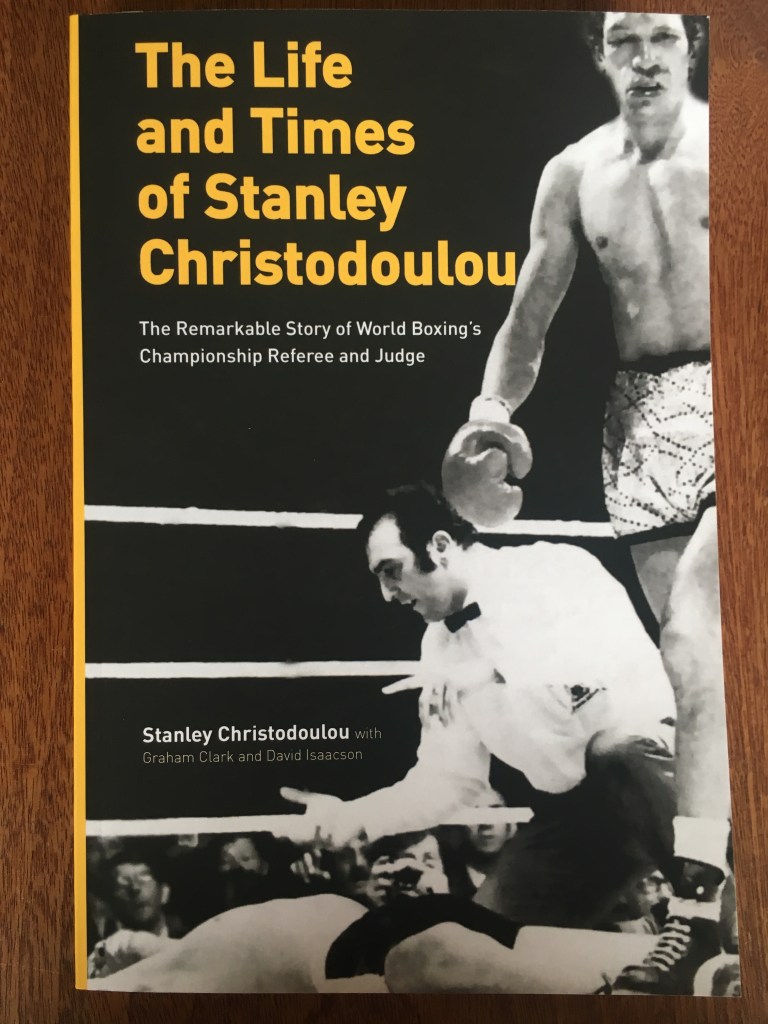
This photo, also used on the cover of the autobiography of world class South African referee Stanley Christodoulou, is the one that begins this article.
A year or so later Bert Blewett took over the editor’s chair and under his guidance the magazine became highly regarded worldwide until he resigned in August 2004.
But let’s get back to the photograph of Galindez and Kates. The photo is most striking with blood streaming down the face of Galindez from the gash over his right eye.
There is no mention of who took the photograph but inside the magazine there are several action pictures taken from the fight, and it mentions pictures by Bill Handley and Tony Stapelberg.
Reading through Fight magazine in 1946, this started my love affair with the fight game, firstly as a collector, commentator, boxing writer and historian.
This love affair has become a passion that is not easy to define, but I enjoy every minute of my involvement with the sport and its people and would not change it for anything else.
This fight with the Arnold Taylor v Romeo Anaya epic, must rank together with Galindez v Kates as possibly the two greatest fights in the history of South African boxing.
The cut eye, the drama of the fight and the blood-stained shirt of referee Stanley Christodoulou, possibly one of the greatest in the history of the game, come flooding back to me every time I pick up the first copy of South African Boxing World.
Speaking to many collectors of boxing memorabilia, there’s always a special photograph that tells the story.
South Africa’s top collector of boxing photographs must be ex-fighter Jeff Ellis, who has an estimated 30 000 photos in his collection and spends most of his day scanning photographs and placing them on his computer. A pastime all boxing fans and aficionados would surely enjoy in their retirement !
As oft’ uttered “A picture can say a thousand words”. No more so than in the sport of boxing.
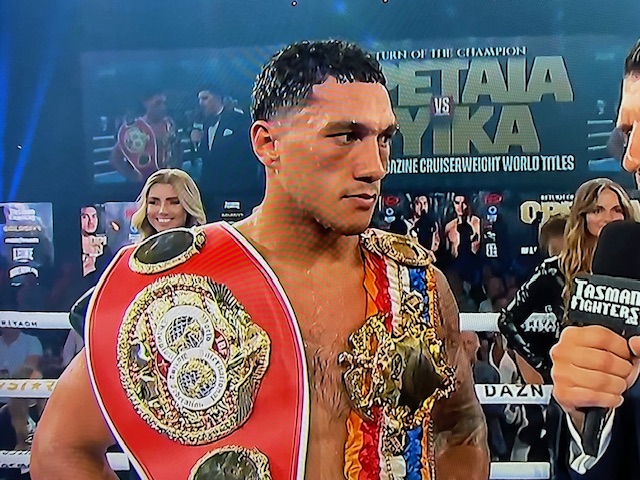
Ring Magazine and IBF world cruiserweight champion Jai Opetaia.
Just three weeks into 2025 and the race to be the highly subjective Pound-for-Pound and ‘boxing’s best’ is on !
First to stake his claim, on 8 January, was Australia’s current ‘world’ cruiserweight king Jai Opetaia, who beat his IBF challenger David Nyika with a devastating fourth round knockout. ‘Chilling’ rightly summed it up.
Being holder of the prestigious Ring Magazine title is usually confirmation of divisional dominance and your place amongst boxing’s elite. But, who is top of the tree ? Who cares ? Well, we do for one.
The pound-for-pound crown, as subjective as it may be, based on one’s personal opinion, is what boxing debates are all about. So, who is the #1 King ?
Ukrainian heavyweight Oleksandr Usyk by virtue of cleaning out the world heavyweight division in the last two years, the flagship of the sport, is generally accepted as the pound-for-pound King. His double victories over former world belt holders Tyson Fury and Anthony Joshua, plus stopping current IBF champion Daniel Dubois are proof of this.
The Ring magazine’s current ‘Pound-for-Pound’ list is;
Oleksandr Usyk (23-0, 14 KOs)
Naoya Inoue (28-0, 25 KOs)
Terence Crawford (41-0, 31 KOs)
Artur Beterbiev (21-0, 20 KOs)
Dmitry Bivol (23-1-0, 12 KOs)
Jesse Rodriguez (21-0, 14 KOs)
Saul Alvarez (62-2-2, 39 KOs)
Gervonta Davis (30-0, 28 KOs)
Junto Nakatini (29-0, 22 KOs)
Devin Haney (31-0, 15 KOs)
Ironically, Jai Opetaia, despite boasting a 27-0 (21 KOs) record is just outside their top ten.
What is the usual staple criteria for entering and remaining in this list is preservation of the ‘O’ , signifying no losses. Saul ‘Canelo’ Alvarez being the exception to the rule, based on his longevity and elite win record. He has moved through the divisions capturing world straps from 140lbs (10st) to 175 (12st, 7lbs).
This moving through divisions and, largely dominating, is the next criteria for universal acceptance. It is always argued though depending on whether they just passed through or really were the champion. In recent years Floyd Mayweather and Manny Pacquiao were good examples of this, although no one can dispute their boxing hall-of-fame status.
Next up, this Friday (24 January) in Tokyo is #2 pound-for-pounder ‘The Monster’ Naoya Inoue, who faces big underdog Ye Joon Kim (21-2-2, 13 KOs) in defence of his undisputed junior-featherweight (122lbs/8st, 10lbs) crown. Another Inoue victory may secure his listing status, but will not be sufficient to elevate him to #1 in most observers eyes, however emphatic his win.
It would be devastating if the Japanese lost to his Korean challenger, but that is highly unlikely Friday or, in the immediate future.
Coming in at #3 in The Ring list is Terence ‘Bud’ Crawford. In the eyes of many, particularly those Stateside, the boxing boss. His record is outstanding and he’s the epitome of moving through the divisions and capturing multiple ‘world’ titles.
The big pound-for-pound match coming up is in Riyadh, Saudi Arabia on 22 February between Russian ‘world’ light-heavyweight champions Artur Beterbiev and Dmitry Bivol. This highly anticipated rematch of their close fight last October will determine #4 and 5, and possible elevate one of them to pound-for-pound king. Beterbiev currently holds their superiority and Bivol’s former WBA title by virtue of his narrow earlier points victory.
The world powerbroker of boxing based on the Saudi state financial resources at his disposal, his passion for the sport and, his personal endeavours to back the sport and make the fights that matter, is His Excellency Turki Alalshikh. In many ways, in the background, he will be the Kingmaker. Him being the current owner and custodian of The Ring it is here it will be confirmed to the majority of boxing observers and aficionados.
Alalshikh is reportedly looking to make a highly lucrative and anticipated match-up between ‘Canelo’ Alvarez and ‘Bud’ Crawford. There’s the ‘small’ matters of further negotiation and the current fighting weight differential of 14lbs/1 stone) between them (Canelo at super-middleweight and Crawford at junior-middle). It’s sure to be mouthwatering if it happens, most likely at a median ‘catchweight’.
For now, let’s just enjoy the ride, its twists and turns over the coming twelve months, as the fighters jostle for the ‘pound-for-pound’ crown and to be boxing’s King.
Naoya Inoue will be shown on Sky Sports in the UK around Friday lunchtime and on ESPN+ in the USA.
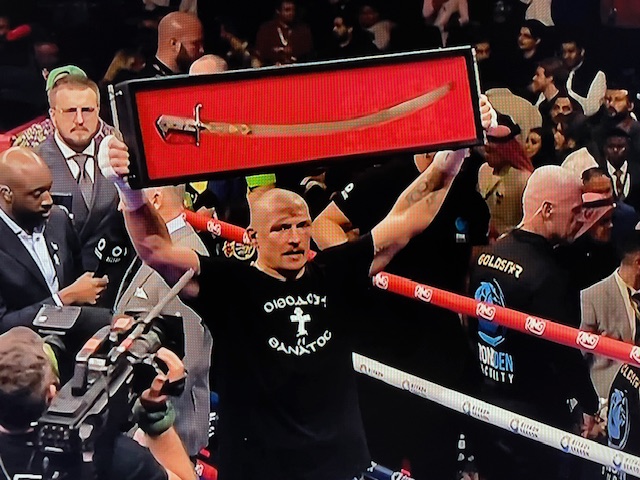
One of the victory spoils for Oleksandr Usyk in Saudi Arabia.
Hail to the King !
Lineal and unified world heavyweight champion Oleksandr Usyk successfully defended his sanctioning body titles on a 116-112 three judge unanimous points decision last night in Riyadh, Saudi Arabia. In a captivating fight he defeated former WBC champion Tyson Fury, the slight underdog going in.
The Ukrainian champion raised his record to 23-0 (22 KOs) with a technically flawless performance to ultimately outwork the four stone heavier and six inch taller Briton.
It was his second defeat of Fury (34-1-2, 22 KOs) who looked good, but was not quite good enough.
Fury again made a superior start winning the opening round, before Usyk, commanding the centre of the ring for most of the middle rounds, eventually took control as the fight developed. The challenger had his successes, but they weren’t prolonged enough or consistent.
It lacked the drama of their first encounter back in May, with no knockdowns on this occasion. The majority of rounds were close and tight to score but, although we had it a round or two closer, the final outcome was correct in our view.
Usyk now moves onto whatever challenges remain, but his legacy as a supreme champion and operator are secured. Among his accomplishments are Olympic gold, and undisputed professional titles at cruiserweight (200lbs/14st,4lbs) and heavyweight. He has beaten all comers in getting there and remains undefeated.
A defence and chance to regain the IBF title from Britain’s Daniel Dubois who he defeated by KO in 2023 would appear his most likely option if he were to continue, but he is a future hall-of-famer regardless.
Fuelled on by the military tension in his country of Ukraine, who continue to defend their homeland, he has no more to win inside the ring to secure his already iconic status among his compatriots and the boxing fraternity. The choice is his.
In the Kingdom Arena, Riyadh, Saudi Arabia tonight the heavyweight championship of the world will be contested with the victor the next champion.
Credit to Britain’s Daniel Dubois for picking up the IBF heavyweight title in the last six months and successfully defending it, but the so-called ‘linear’ champion at the end of tonight’s fight will be either Ukraine’s Oleksandr Usyk or another Briton Tyson Fury. They will be the outright King.
If you haven’t a clue about them or the event, then you don’t follow boxing.
It’s a rematch that promises much between two extremely talented boxers who have consistently performed and delivered at world level. To read a brief note of their respective records and strengths just flip down one article on this page to the LunchBox.
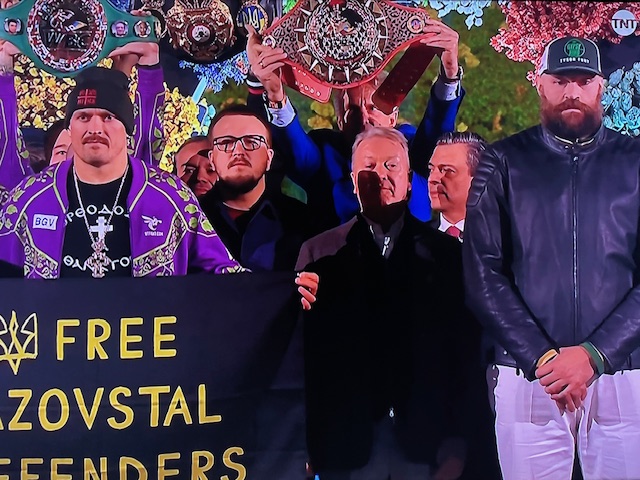
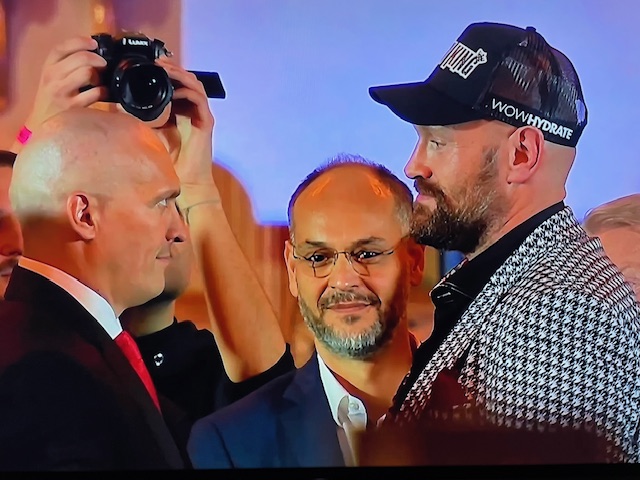
Both men weighed in last night at, by recent comparisons, a subdued event with little drama. The almost eleven minute face-off was at the final press conference two days earlier.
The key point last night was the weight differential (challenger Fury 281 lbs, and champion Usyk 226 lbs). In Imperial weights the Ukrainian almost four stones lighter.
Any other walk of life, unless the biblical David v Goliath, this would make a difference. Usyk though is special and appears undaunted.
Fury weighed in with a leather jacket and trousers on. Unique, but very strange. For a man who does not need to emphasise his far larger body frame, it was very strange. Maybe a tactic to emphasise the point even further ?
Don’t doubt, that this is contest of historical proportions.
The rich history of the sport is defined firstly by the heavyweight division. There’s a saying in it “As the heavyweight division goes, so goes boxing”.
The division is remotely healthy by historical comparison. Ultimately though, given the hype, investment and what’s at stake, this fight has to deliver. We expect it will. Their first meeting back in May 2024 was a barnstormer. Usyk winning by a deserved, but split-decision victory, after twelve hotly contested rounds.
Usyk is absolute quality, fighting and winning out of his southpaw stance. Given the challenges facing the Ukrainian nation currently, this will further add to his motivation.
Fury, ‘The Gypsy King’, by comparison, has the motivation of revenge and the representation of his travelling community. He will not back down. It promises to be another close and competitive contest.
There’s another old adage in boxing “A good big ‘un, will always beat a good little ‘un”. Usyk, so far, has been one major exception to the rule. The oddsmakers, pundits and so-called experts are hesitantly, but ultimately firmly, picking Usyk to successfully defend his championship tonight.
After another excellent contest, we say “Expect a trilogy !”
Heavyweight champion Usyk looks up to former champ and challenger Fury.
Here we go !
The immediate future of the heavyweight division will be determined in Riyadh, Saudi Arabia this coming Saturday (Dec 21). Ring Magazine champion and undoubted number one Oleksandr Usyk (22-0, 14 KOs) faces former WBC champion Tyson Fury (34-1-1, 24 KOs) for a second time.
The latter will be motivated by the rematch opportunity, having been soundly beaten, albeit on points, in the first encounter. Usyk surpassed his previous outstanding accomplishments as an amateur, (2012 Olympic champion) and undisputed cruiserweight champion, by trading and defeating a ‘big’ heavyweight in Fury. The British ex-champion was edging the early rounds, but started to coast and got tagged and almost stopped in the dramatic ninth round. He survived this to lose a close, but in our view, clear decision. Surely he will adopt a different approach in the rematch.
Fury has a seven inch reach advantage and is six inches taller. He must maximize these advantages to prevail. In another close and competitive fight we predict he will get the job done.
Enjoy the week ahead and monumental action to end it.
Ron Jackson – Esteemed South African boxing writer and historian.
Forgotten Facts in South African Boxing
Reading through old newspaper reports and magazine articles, one comes across fascinating and long-forgotten facts.
For instance: Johnny Squires, who won the SA heavyweight title on 12 August 1922 when he stopped Nick van den Berg in the eleventh round at the Durban City Hall, was the first South African to top a bill at Madison Square Garden in New York. He fought WL “Young” Stribling at the famous venue on 6 September 1928.
Squires took a solid punch in the first minute of the fight and his left eye was almost closed soon afterwards. He was also bleeding from the mouth and went down near the end of the round after being hit with a big left.
He made a mistake by jumping up without taking a count and soon went down again, this time taking a count of five.
Early in the second round, Stribling landed a few solid punches to the head and the referee stopped the fight after only 44 seconds of the round.
Deaf-Mute In the Ring
When Ernie Eustice, a future SA featherweight champion, fought Scottish champion “Deaf” Burke in Johannesburg on 7 April 1926 an unusual problem had to be solved.
Burke was a deaf-mute, and everything had to be written down for him to communicate.
Tiny Dean, the referee, said if there was a knockdown he would “pass” his hand in front of Burke’s eyes.
All was well until Burke was knocked down in the third round. With his head between his knees, he was, of course, unable to see Dean’s hand.
Thinking fast, Dean tapped him on the neck as he counted. But after reaching nine, he forgot that the Scot could not hear, and he shouted “Out!”
One Of The Best From The Free State
Johnny Ralph who won the SA heavyweight title in February 1947, was one the best boxers to emerge from the Orange Free State. However, he failed in fights against Freddie Mills and Bruce Woodcock losing inside the distance on both occasions.
But there have been other Free State fighters of note. One was Tom Holdstock, who represented South Africa in the light-heavyweight division at the 1920 Olympic Games in Belgium. He also fought as a professional, competing in the heavyweight division from 1923 to 1933.
George “Boer” Rodel, also a heavyweight, was born on a farm near Kroonstad on 14 September 1887. He fought from 1911 to 1916 and also campaigned in England and the United States, with a fair amount of success.
SA heavyweight champion Johnny Squires was born in Bloemfontein on Christmas Day 1901. He had a few fights in Australia and won on points over ten rounds against Johnny Risko in the US. He also drew with Ted ‘Kid’ Lewis in Johannesburg in January 1928.
Len McLoughlin won the SA amateur bantamweight title in 1929 and was eliminated in the 1930 Empire Games trials by the celebrated Laurie Stevens from Johannesburg. As a professional, McLoughlin won the SA featherweight title by defeating Willie Smith in July 1932.
Jopie Greyling, also born in Bloemfontein, was an outstanding amateur. He won the SA junior welterweight division in 1953 and 1954 and the welterweight gold medal at the 1958 Commonwealth Games in Cardiff, Wales.
Stevens Shocked At The Wanderers
A memorable fight took place at the Old Wanderers Ground, in Johannesburg, on 3 November 1934 when SA lightweight champion Laurie Stevens met an Italian, Aldo Spoldi.
Stevens, in his usual dashing style, rushed in with a body attack in the opening round but was knocked down for the first time in his career. He rose at the count of eight, but the Italian immediately sent him back to the canvas again.
Stevens forced himself up at the count of six, but Spoldi rushed in and knocked him down again. The South African was saved by the bell and was dragged back to his corner by his cornermen.
Somehow, he won some of the following rounds as the Italian began to tire. Many spectators felt Stevens was fortunate to come away with the decision.
Holloway And Malone Fight To A 73-Round Draw
In another epic encounter, Jim Holloway and Barney Malone drew over 73 rounds on a farm on the Old Kimberley Road on 3 July 1893.
Prizefighting was illegal at the time, but policemen guarded the fighters as they made their way to the venue.
The fight began at 07:45 and was declared a draw at 13:00.
Peter Mathebula – First Black South African To Win A World Title
Against the odds, South Africa’s Peter Mathebula became the first black South African fighter to win a world title when against the odds he travelled to Los Angeles and on 13 December 1980 outboxed the Korean Tae Shik Kim over 15 rounds to win the WBA flyweight title.
Tsietse Maretloane Wins Supreme Title
Tsietsie Maretloane became the first South African fighter to win a Supreme title when he beat Freddie Rust in Cape Town for the South African featherweight title.
“Tap Tap” Makathini – One of the Best
Southpaw Elijah “TapTap” Makhathini was the first of the Black South Africans to make the most of the new opportunities when the South African apartheid government allowed black fighters to meet white fighters. He won the supreme South African middleweight title when he stopped Jan Kies and remained a dangerous puncher at the top level until his retirement in 1980.
Possibly Makhathini will always be remembered for the stunning knockout of Charlie Weir in Durban on 25 April 1979 and his knockout of the hard-hitting Daniel Mapanya.
Norman “Pangaman” was an outstanding fighter, but Sekgapane who was born at Tafelkop in the Koster district in the Western Transvaal on 12 March 1948, had an outstanding career, but rather sadly when he met Antonio Cervantes in Mmabatho on 29 August 1978 for the world junior welterweight title, he was possibly just past his best and stopped in the ninth round.
One of the greatest South African fighters never to have won a world title was Nkosana “Happyboy” Mgxagi who on 14 April 1979 challenged the Puerto Rican holder of the world WBA junior lightweight title Sam Serrano, at the Cape Showgrounds at Goodwood, Cape Town.
Early in the fight Mgxaji presented Serrano with a few problems and had a brief moment of glory when he dropped the champion with a right to the jaw in the fifth round.
However, he never followed up and Serrano ended the fight with a left hook followed by a right in the eighth round as Mgxaji’s seconds threw in the towel.
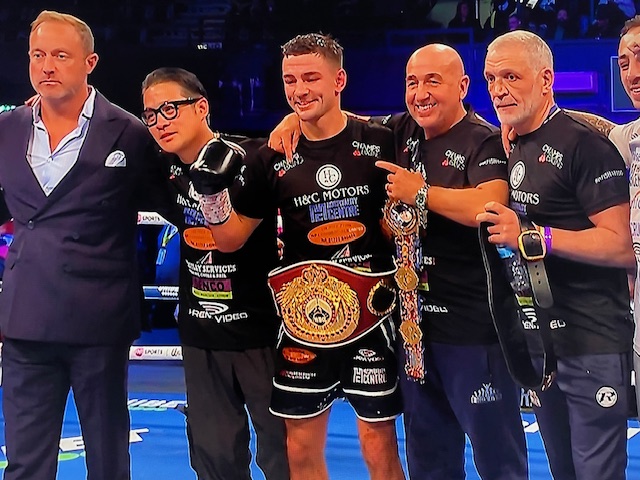
World ranked lightweight Sam Noakes (belted) celebrates with his team.
On the excellent ‘Magnificent 7’ Queensberry card at Wembley Arena on Saturday (Dec 7) two British fighters took big steps towards world honours.
Top of the bill was the British middleweight title fight which saw Battersea, London’s Denzel Bentley take the Lord Lonsdale Belt for a third time with a unanimous, but closely fought victory over Brad Pauls.
Despite horrific travelling weather conditions the well-supported ex-champion from Cornwall, England, with his vocal and committed followers was making his first defence of the title and put on a brave effort to retain it.
Bentley, the bigger puncher of the two gave a seasoned performance, working off a strong jab and scoring a late rounds knockdown that sealed the deal. Pauls suffered a fractured left eye socket in the process, but was competitive to the end.
The new champion (21-3-1, 17 KOs), also picked up the European and WBO International titles and secured his position as mandatory challenger for the WBO title. He longs for a second crack at a ‘world’ title.
Also mightily impressive was undefeated lightweight Sam Noakes from Maidstone, Kent, England who defended his British, Commonwealth and WBO International titles at 9st, 9lbs (135lbs). The 27 year old won every round on two cards, dropping one round on another, against 38 year old veteran Ryan Walsh. The fight was competitive and riveting throughout, and gave the world ranked Noakes the opportunity to showcase all his skills. His mixing up of power shots, patient advancement and body punching were particularly impressive.
Noakes was forced to go the distance for only the second time, but dominant throughout. He takes his record to 16-0 (14 KOs) and is perfectly placed to tackle any of the lightweight world belt holders. Denys Berinchyk, the WBO champion, is the most likely target and possibly easiest to negotiate for.
The Maidstone man continues to impress with every outing and if given the chance could be in for a stellar 2025.




 The Undisputed