The Weekender

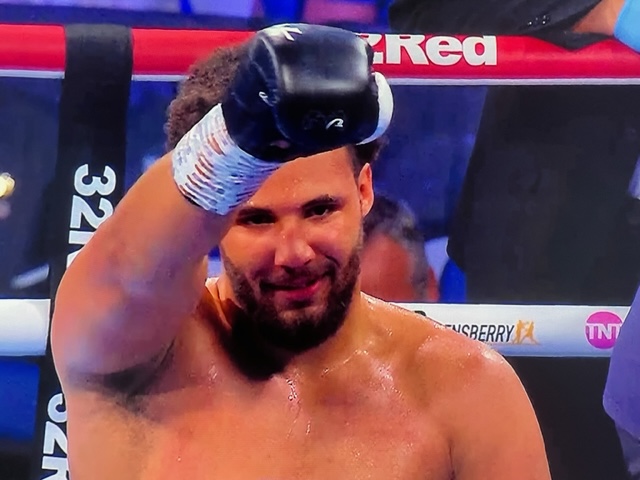
Another previous KO win for Moses Itauma.

If you believe the hype and copy on world heavyweight contender Moses Itauma you’d think we have an emerging Muhammad Ali, Mike Tyson, Frank Bruno and Lennox Lewis all rolled into one !

The undefeated 20 year-old boxing out of Chatham, England is good, and to date, has massively impressed doing more than he should do by this stage of his career. With a cold, calm demeanour he’s compiled a 12-0 (10 KOs) record containing some devastating knockouts, clearly beating some seasoned campaigners to warrant the excitement of a new emerging talent.

Itauma could fill the massive void to be left by undisputed world champion Oleksandr Usyk when he inevitably hangs his gloves up sometime soon. At 38, and having beaten (sometimes twice) all champions and challengers and, with his legacy secured, the end is surely in sight for Usyk.

The big British southpaw, Itauma, a former amateur world youth champion, could be Usyk’s heir-apparent but, by heavyweight comparisons he really is a ‘boxing baby’. His management team Queensberry Promotions, to their credit, still know they have a diamond in the rough. Francis Warren, eldest son of hall-of-fame promoter Frank, is talking cautiously but with more than a twinkle of optimism in his eyes.

Tonight in Riyadh, the Kingdom of Saudi Arabia we will ultimately know more when he faces former world title challenger Dillian Whyte (31-3, 21 KOs). At 37 years old, the fellow Brit is at the opposite end of the boxing spectrum, but Itauma’s first legitimate test at world title level. Whyte holds good wins over Joseph Parker and Derek Chisora (twice), plus gave Anthony Joshua all he could handle.

The odds though are heavily stacked in the younger man’s favour, being viewed as a fringe contender ‘changing of the guard’. If, as widely expected, Itauma bombs out the man from Brixton, London then the hype and excitement will gain further momentum, and justifiably so.

Whilst not being over-surprised if that outcome results, we expect the well-trained and lighter than usual Whyte to give it a good-go for as long as it lasts. He’s been a top contender for close to a decade and can also bang a bit himself. His fighting pride and quality at the highest level will not allow him to be humiliated (ala Ken Norton by an emerging Gerry Cooney or Gerrie Coetzee by Frank Bruno).

In many ways Itauma-Whyte is the most intriguing fight on a good bill, but the likely ‘fight of the night’ will be the co-main event between undefeated featherweights Nick Ball and Sam Goodman. It pits an English world champion, in Ball, as recognised by the WBA, against an Australian. The summer before an Ashes cricket winter will draw out the best from undefeated fighters from these two proud sporting nations.

‘Wrecking’ Ball from Liverpool, England has compiled a 22-0-1 (13 KOs) record and Goodman is at 20-0 (7 KOs).

The KO ratio favours the Brit and he’s competed at the higher level to date. This should be a real slugfest as Ball fights at a high pace, continually coming forward. We expect him to prevail in a very competitive fight.

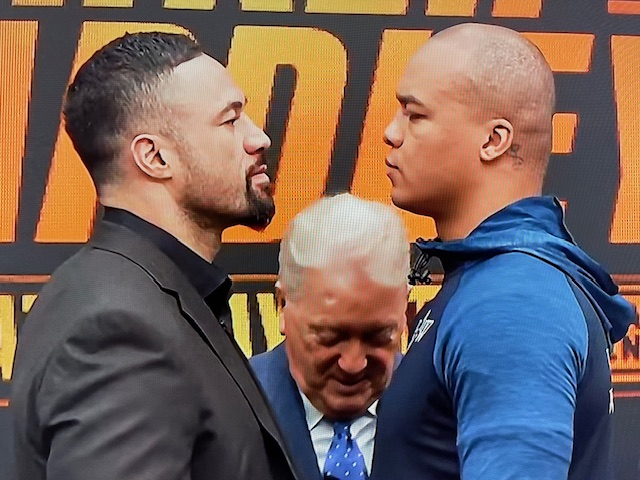
Another good match-up is between two heavyweights who’ve some question marks against their ability to break through to world title contention, in Britain’s David Adelaye (14-1, 13 KOs) and Croatian Olympic medallist Filip Hrgovic (18-1, 14 KOs).

Hrgovic has the better resume having only lost to former IBF world champion Daniel Dubois. Both can still compete and eat at the heavyweight table, but a win is essential for either to push on. This is a pick ’ems in our view.

The fights are available on the DAZN streaming site, as a pay-per-view (box office) package. The main fights can also be heard in the UK on talkSPORT radio. Either should be worth considering.

Ron’s Reflections

South African Boxing Hall of Fame

When Chris Lessing died on June 1, 1976 at the age of 43 at Garden City Clinic in Johannesburg he left behind a superb collection of boxing books, autographed photos of  famous boxers, 16mm films and museum  memorabilia including statuettes, trophies and signed gloves.

Subsequently his collection was donated to the South Africa Boxing Board of Control who established a Chris Lessing Boxing Hall of Fame which was housed at their offices in the Fattis and Monis Building in Johannesburg. The museum was under the curatorship of long time sports writer Bill Bosch.

On October 12, 1979 at the official opening of the museum and the first ever South African Boxing Hall of Fame ten boxers were inducted into the Hall and it was reported that elections to the Hall of Fame would be held on an annual basis.

The Boxing Hall of Fame was divided into three categories. The Pioneer Group for boxers who were active before the first World War, the Oldtimers Group for boxers who fought between the two World Wars, and the Modern Group for boxers who were active after the second World War.

 The first ten ring greats to be honoured were:

Pioneer Group – James Robertson Couper and Arthur Douglas.

Oldtimers Group – Don McCorkindale, Ben Foord, Willie Smith and Laurie Stevens.

Modern Group – Vic Toweel, Arnold Taylor, Jake Tuli and Pierre Fourie.

Subsequently the museum was down sized when the Boxing Control Board moved offices to Nasrec and Midrand. 

It is believed that over the years a lot of the memorabilia has disappeared but there are still were still a number of items held by Boxing South Africa at their offices in Pretoria.

However, over the years many items have gone missing and there is a story which has never been substantiated that at one time a leading boxer visited museum and remarked that the gloves which were marked as being those of the Welshman Jimmy Wilde, considered by many to be the greatest world flyweight champion all-time were not a pair of gloves as they were both left hand gloves.

What has happened the items is unknown.

Rather sadly in recent years there has been very little interest in establishing a South African Boxing Hall of Fame.

Some time ago a South African Boxing Hall of Fame was established at the Sun City Resort in the Pilansberg in the Northern Province.

However this is was not a Hall of Fame in the true sense as there are not annual elections in the various groups. Brian Mitchell South Africa’s most successful boxer of all-time was the host and conducted interviews with well-known South African fighters, which went down well with everyone. It made up for the time being.

Ron Jackson

The Friday Faceup

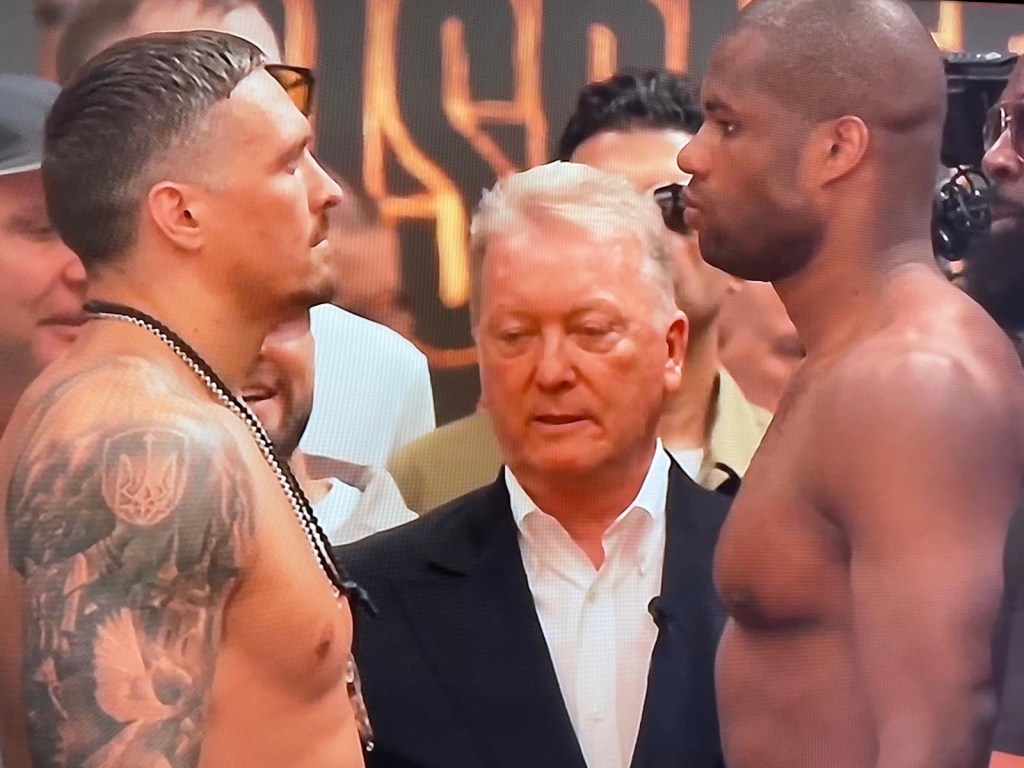
Heavyweight champions Usyk (left) and Dubois at today’s weigh-in.

This is BIG.

In the context of the 150+ year history of the Heavyweight Championship of the World, the fact that it fills Wembley Stadium, London with some 90,000 spectators, and, as they love to say, it’s “For all the marbles”.

Factor in a worldwide TV audience, albeit the majority through the new phenomena of streaming sites (DAZN in this case) and the purse bids up for grabs, it’s huge.

The ‘Undisputed’ heavyweight clash, the very name upon which the site you’re visiting was chosen, it’s a mouthwatering prospect.

Ukrainian world champion Oleksandr Usyk (23-0, 14 KOs) risks his almost dominant heavyweight status against Britain’s Daniel Dubois (22-2, 21 KOs). The latter a Londoner, in his hometown, faces the ‘road warrior’ who because of the military conflict in his own country caused by Russian invasion, has had to hit the road again. This is also the lucrative option and he will be paid heavily wherever he goes.

As the crowning moment of this year’s Riyadh Season the accepted lineal champion Usyk brings the WBC, WBA and WBO world championship belts to the party. Dubois the IBF strap. No splinters of the title will be uncontested on Saturday night. That in itself is a rare luxury and justifies the Saudi investment.

In a final press conference held yesterday in the banqueting suite at Wembley Stadium the fighters came face-to-face for almost the final time before the opening bell. Only today’s weigh-in remains.

‘ Dynamite’ Daniel Dubois (aka DDD) entered the fray with “I’m on a different level now…I’m ready to make history. I’m gonna do a real demolition job and I’m ready for it !”.

Usyk responded “Hello London, I’m happy to be here again because I believe for this – Ukraine”, and gave the victory salute to emphasise on both counts. Asked about his challenge ahead he replied “Every fight is important for me. Now, it’s very important for my country and soldiers who protect my country”. Everyone in attendance listened tentatively and this there could be no denying.

International Boxing Hall-of-Fame promoter and Queensberry Head, Frank Warren, added to the hype, “It’s a historical and phenomenal fight…unbelievable, competitive and great fight”. This is to be confirmed, but the match-up is a sure thing.

It’s a rematch two years on from Usyk controversially beating Dubois in Wroclaw, Poland after being dropped by a borderline body shot and being allowed to recover by the referee temporarily stopping the fight before the Ukrainian rallied again to get a ninth round stoppage.

Since then, Dubois has been nothing short of sensational racking up three consecutive victories against world title challengers, the zenith being his devastating stoppage of fellow Brit Anthony Joshua in the same venue last August.

So what can we expect Saturday ? An older Usyk as his career moves towards its close having beaten all-comers and challengers to win and unify heavyweight titles. A much improved and confident Dubois.

Dubois’ camp headed up by chief trainer Don Charles believe now is his time. Having worked together for two years the Brit is as Charles said “Destined to make the impossible, become the possible”. The twice beaten IBF champion has improved significantly since his first loss to Joe Joyce during COVID lockdown, and considerably since losing to Usyk in Poland.

Frank Warren earlier cited Dubois’ excellent jab which was “understimated”. This is fact, resulting from his graduation from the Team GB centre of excellence and his progress as a pro since. He knows how to box his way in to unleash his ‘dynamite’ power.

Whether this will be enough against the London 2012 Olympic heavyweight gold medallist and undisputed former cruiserweight and heavyweight world champion remains to be seen. We expect Usyk’s advancing years, now 38, and Dubois’ youth at 27 to be telling factors in how the fight goes, in possibly an explosive start followed by a cagey middle rounds, with the southpaw Usyk not wanting to fully exchange, but gradually using his elite experience and ring know-how to prevail.

We see Usyk stopping the Brit by round ten, but it will be exciting whilst it lasts. Enjoy !

Newsflash – Weights – Dubois 243.8 lbs, Usyk 227.3 lbs.

The Monday LunchBox

As a survivor from the last Benn-Eubank dust-ups, prior to a sensational Saturday night (26 April) at the Tottenham Hotspur stadium, north London, I feel I’m well placed to put it into context.

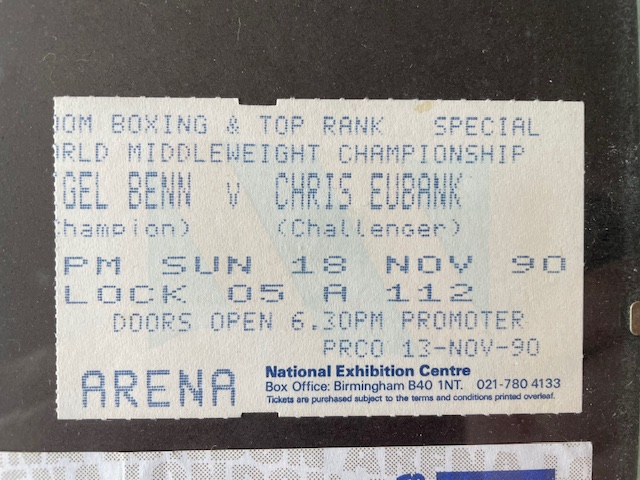
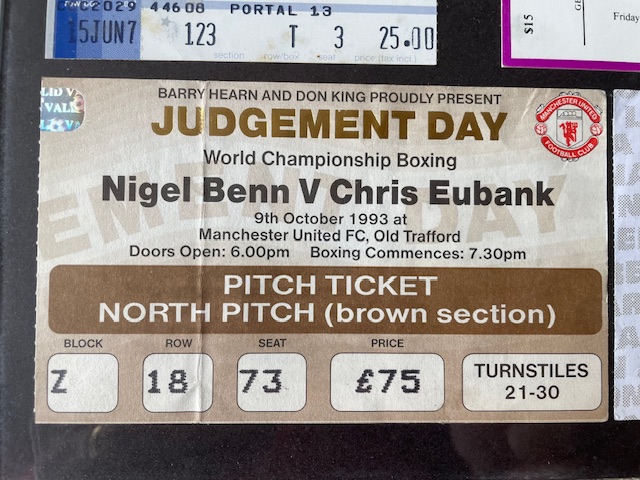
Firstly, the highest compliment I can give the enthralling twelve round middleweight non-championship fight is that “It was as good as any of their father’s previous two encounters”, of 1990 and 1993 respectively. I bore witness to the hype and intensity of those meetings first hand, on-site in an excellent seat for both. I was also close to what was happening behind the scenes.

Whilst Saturday may have lacked the drama and knockdowns of the 1990 Birmingham NEC fight and the controversy of the rematch at Old Trafford, it more than equalled in their theatre and intensity.

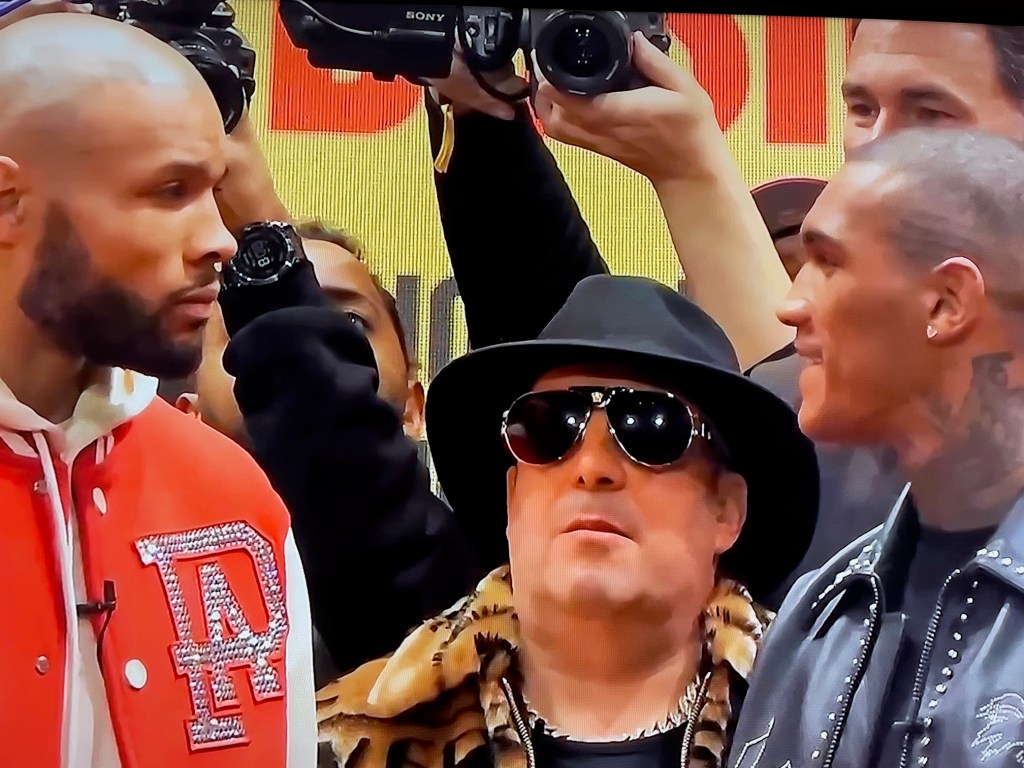
The near 65,000 in attendance and millions ‘stumping up’ again to watch on box office/pay-per-view/stream (or whatever you want to call it) were not disappointed with the quality on-show throughout the evening and in particular the climax between a super-middleweight/middleweight Chris Eubank Jnr. and a rising welterweight Conor Benn.

Both, the latest in the fistic bloodline (and almost dynasties) of their respective families. The former now 35 years old and the latter 28. None have yet become world champions, but after Saturday night are sure to challenge at some point for one of the splintered titles that are now available in this generation.

The venue was fitting for a match of this interest and hype. The soccer stadium being the most spectacular recently constructed in London and with state of the art facilities. The electricity in the air as dusk moved in was evident, even from my couch !

On this occasion, I decided that I would watch from the comfort of my living room as the evening unfolded. I elected to pay for that ‘privilege’ to what used to be available ‘free to air’. Those days I know are long gone !

After an excellent undercard brought together by The Ring magazine, Saudi investment, Matchroom and BOXXER promotions, among others, THE main event was imminent. The competitiveness of the so-called ‘Co-main event’ between Anthony Yarde and Lyndon Arthur in their trilogy fight at light-heavyweight set the tone.

It was an excellent match-up and, it delivered. On our card we thought Arthur just edged it by taking the last round, but the judges saw it the other way. Yarde being victorious. It was so enthralling, being more of a bludgeoning chess match than the actual main event, that a fourth match-up would be welcome. Both will move onto other challenges though we’re sure.

With the venue rocking as the two main eventers emerged from their dressing rooms and shown on the big screen the electricity was ramped up. As a domestic viewer hopes, you could feel it emanate from your television screen.

We knew Chris Eubank Snr. Would finally show up ……resplendent in his shin-length mock flying jacket/coat, with fur to spare ! He looked the same eccentric we had come to love three decades ago.

Nigel Benn was always going to turn up and backed his son throughout the weeks of build-up. Thankfully both seniors met and embraced each other on numerous occasions though the event.

The promoters and fighters did well to mimic and reminisce about the senior’s previous encounters with the ring entrances and fighting attire. I knew Conor would come out to the chimes of Big Ben and strains of ‘Dangerous’, ala his father. It took a while for the latter sounds to kick-in but, they came.

Eubank Jnr. Would inevitably come into Tina Turner’s anthem ‘Simply the Best’. Both son’s also donned copies of the shorts their father’s wore in the first 1990 fight. On conclusion of the twelve rounds, when the decision was given and Eubank Jnr. announced the winner he dropped to his knees like his father back in the NEC. That was full circle and absolute sporting theatre.

Both fighters gave it their all throughout in a real toe-to-toe contest. Skills were evidently shown and one area of my being surprisingly impressed was the strength of Benn’s chin. He took and withstood shot after shot from his adversary. This his father showed many years back too, but in the first fight eventually succumbed to Eubank Snrs. power.

If any fight warranted a rematch this, is it. The contest was excellent entertainment and both came out with the shields and heads held high. An immediate rematch has been mooted for September, but boxing politics is a fickle thing. We can only hope that, like their father’s, that hostilities are repeated. Only then will we know who truly is the better boxing family.

If it doesn’t materialize, then the family boxing pedigree and legacy of each is up there and has been one to behold.

Congratulations to all involved. Boxing is back in the mainstream.

The Fight.

Image and promo courtesy of Top Rank Inc.

When I, and seldom others ask me, “So, what got you into boxing ?” I think; 1) about my father who loved and competed in the sport with a passion, and 2), back to April 15, 1985.

Yes, it was exactly 40 years ago tonight !

That was the night in a temporary ring in Caesars Palace, Las Vegas resort and casino car park, before 15,141 on-site, that the soon to be universally coronated ‘Marvelous’ Marvin Hagler faced Thomas ‘Hit Man’ Hearns, or ‘Motor City Cobra’ if you prefer.

The former above, successfully defending his undisputed world middleweight championship for an eleventh time.

This would still be three short of Argentina’s Carlos Monzon. The rest however, would become folklore and history.

‘The Fight’, also christened ‘War’ by the champion, was hotly anticipated and broke all box office records at the time. It pitted the ‘blue collar’ fighter in Hagler, who claimed he’d been denied his plaudits and the riches that should’ve by now come with it, and, The Ring magazine’s 1984 Fighter of the Year and, ’til then WBC junior-middleweight champion, Hearns.

The fight took place on a Monday night (early hours Tuesday in the UK). It would be promoted by Bob Arum’s Top Rank Inc. shown on closed-circuit TV, live via satellite and, in a delayed network highlights package on ITV Sport.

The excitement and anticipation leading up to it was fever pitch. Hagler was coming off a strong tenth defence against Syria’s Mustafa Hamsho. Hearns, a poleaxing of soon-to-be living legend Roberto ‘Hands of Stone’ Duran, inside two rounds, and an equally impressive KO of Freddie Hutchings.

The April 15 event and contest didn’t disappoint.

Both fighters came out from the opening bell like possessed infantryman on entering a combat zone.

The champion’s career mantra was ‘Destruct and Destroy’ and this he emphatically tried to do. He was met by an equally immovable object and bludgeoning windmill, in the form of the ‘Hit Man’. The opening round would go down as one of the top 5 in the annals of boxing history. The list possibly headed by Jack Dempsey vs Luis ‘Wild Bull of the Pampas’ Firpo in September 1923.

On the night, according to the statistics, Hearn’s landed 56 punches to Hagler’s 50 in the opening firefigtht.

On the round’s conclusion, with both fighters shook numerous times and withstanding the oncoming blitzkreig, the bell sounded and both stared across the ring at each other with a dual Charles Manson’esque stare, that would freeze blood. The crowd were in raptures, scarcely believing what they had just witnessed.

Round Two had near-equal intensity, but fatigue was already starting to set in, in particular in challenger Hearn’s liquorice-like legs. The champion who’d been cut on his forehead above the right brow towards the end of the opener, now had blood profusely oozing out.

After Hagler wobbling the Detroit Hit Man early, The Ring magazine summed it up by saying “Hearns was stuck to the ropes like a fly to flypaper”.

Early in the third, referee Richard Steele was forced to intervene to inspect Hagler’s worsening cut and seek the ringside doctor’s opinion. This added to the drama and anticipation.

Allowed to continue; Hagler overwhelmed his foe. “When I saw that blood, I turned into a Bull”, as Hagler would later callously refer to it.

The Ring reported that Hearns “spent most of the third round on his bicycle”.

The end when it arrived was emphatic. The southpaw champion, and soon to be universally accepted ‘Marvelous One’ uncorked successive right-hand southpaw leads and chased a flailing Hearns around the ring. The final looping right ‘sealed the deal’ and the challenger was flattened.

The official time was 2:01 of the third as Hearns lay a stiffened prostrate mass and was counted out.

ITV commentator Reg Gutteridge would famously christen it “Eight minutes of absolute mayhem !”. For me that was just, and my abiding memory of the action that ensued. I also recall from the TV footage a ringside Karl Malden (the actor – he of On the Waterfront and The Streets of San Francisco), who’d obviously lost a fair wager on Thomas Hearns, leaving his ringside seat in disgust. Watch the footage and you will know what I mean.

So enthralled was I with the ferociousness and outcome, that I became a MMH fan overnight and pledged to take a trip to Las Vegas as soon as soon as humanly and financially possible.

I would finish my degree and wait two years to visit with a fellow student and life friend in 1987 for the Hagler-Leonard SuperFight.

Hagler summed it up post-fight saying “Tommy was a little bit cocky, and I had something for him !”. To me this fight summed up the best of the 80’s and best of what this sport had to offer. The ‘Marvelous One’ would forever be marvelous, with a single L.

The defeated Hearns would recover to win ‘world’ titles at three more weights and join his victor in the International Boxing Hall of Fame (IBHoF). Legends both.

Ron’s Reflections

Boxer with no hands

In the first issue of Fight in December 1946, South Africa’s first boxing magazine the lead story was Fight’s Fighter of the month Johnny Le Roux.

It was reported that Johnny Le Roux who was 25-years-old and quoted as one time light heavyweight amateur champion was trying to make a comeback in the professional ring.

Johnny’s entry into the professional ring all began as a bit of a joke, when former British and Empire heavyweight champion Jack London was scheduled to meet South Africa’s Jack Kukard and for some other reason couldn’t keep the date.

London a 126 fight veteran was known to South African boxing fans as he fought former South African light heavyweight and the then current South African heavyweight champion Nick Wolmarans at the Wembley Stadium in Johannesburg on 24 August 1948, winning on points over ten rounds against Wolmarans who was only having his 14th fight.

Eleven days later London travelled to Durban and outpointed Johnny DeVilliers over ten rounds.  

Johnny telephone the promoters to say he would go in against Wolmarans, but did not mean it and had no intention of engaging in the fight even if he was acceptable.

It was just a gag, but there were others who felt that it was more than a gag  as trainer Joe Rosella and John Hadiaris got in touch with Le Roux and had him go through with a couple of workouts and decided if the Board of Control approved they had a new fighter on their hands.

They then let Le Roux go through a couple of workouts in the gym and decided if the Board of Control approved they had a new fighter on their hands.

Gloves with special surgical sleeves were designed to keep them on Johnny’s stumps and then he went into training under the watchful eye of former South African welterweight champion Joe Rosella.

Spectators at the gym were amazed at the footwork and speed of Johnny and also his solid sock.

At 180 pounds (81.65 kg) the question was could Le Roux who was born in Benoni on 27 June 1921 take it even though he could dish it out.

LeRoux first became interested in boxing when he twelve years old and rose to become amateur light heavyweight champion of Johannesburg.

When the Second World War came along he ran away from home to join the   Imperial Light Horse Regiment and saw action up north.

It was in the famous El Alemein Battle that he lost both hands when a shell exploded and when he returned to Johannesburg at the beginning of 1943 he was minus his hands and subsequently went through two operations to have mechanical hands that would permit him .to use the muscles and tendons in his forearms.

However, both operations failed and when he returned to civil life to work at the municipality boxing was far from his mind.

Even though he was at a disadvantage giving away reach and in his forearms; for they were still intact he was prepared to give to ago.

Despite his disability he enjoyed playing soccer, swimming and boxing.

However, it was never recorded if he took part in an actual fight after spending time in the gym sparring.

Ron Jackson

Big George

George Foreman in Barcelona 1992.

Last Friday (21 March) was a momentous one to any sports fan of a certain age.

We sadly lost supreme human being and two-times Heavyweight Champion of the World George Foreman, who passed away in his home state of Texas, USA at age 76.

Over the last few days I’ve poured over countless articles which catalogue his sporting excellence and personality, whilst recalling the remarkable history of his life and outstanding boxing career. I’m sure many more my age will have done similar.

Now settling into my sixth decade, it has never ceased to amaze me what ‘Big’ George experienced and achieved in his life. Let’s merely focus on his boxing career…

In 1968 George became the Olympic heavyweight champion in Mexico City, waving the US ‘stars and stripes’ on victory, at the height of the Vietnam War and the civil rights protests back in his homeland. Some derided him for doing this at a time of intense racial tension and criticism of the US government.

Soon turning professional, he rose to eventually become the heavyweight champion of the world in Kingston, Jamaica in 1973,  destroying a previously undefeated ‘Smokin’ Joe Frazier inside two rounds. He had just turned aged 24 at the time.

His next defining moment was meeting and losing his title to the recognised ‘Greatest’, Muhammed Ali in Kinshasa, Zaire on 30 October 1974. This being the famous ‘Rumble in the Jungle’. George was a heavy favourite going in, but crumbled in the eighth round.

This is etched as one of the most iconic sporting moments of the twentieth century. On this occasion at his expense.

In January 1976 he won his first fight back against fellow American and then-undefeated Ron Lyle in one of the greatest heavyweight slugfests of all time.

George continued up to 1977 until he suffered his second loss to another American Jimmy Young. Post-fight, he had an epiphany moment in the dressing room and announced his immediate retirement from boxing.

He became, and practiced as an ordained minister in Texas for the next decade.

Needing to raise money for a new chapel to preach the virtues of Jesus Christ he turned again to boxing.

His ‘second coming’ was in March 1987, almost ten years to the day since the Young fight. He was 38 and weighed 300lbs. He won his first fight back and went on to compile victory upon victory and rose up the heavyweight ranks again.

On 5 November 1994, at the age of 45, ‘Big’ George would knock out previously undefeated champion Michael Moorer, 19 years his younger, with one monumental right hand to regain the title he’d lost 20 years earlier to Ali. That was remarkable then, and it remains to this day.

To cap it all, on the night, he wore replica red with blue waistband shorts to the ones he’d lost to Ali in, back in the Congo. That night became even more iconic.

George continued boxing and charming everyone for three more years finishing with a record of 76-5 (68 KOs). He inevitably entered the International Boxing Hall of Fame in 2003.

The next phase of his life was arguably more successful, certainly financially, with the launch of the George Foreman Grill. Outside of sports he is now more famous for this.

He married numerous times and had a large family.

His life and career was indeed remarkable and it is the sport of boxing who benefited most from his presence and his undoubted charisma.

Rest in peace George, there will never be another.

Ron’s Reflections

Story of Non-European amateur boxing

Amateur boxing in South Africa began on the diamond fields in the 1880’s when the founder of the De Beers diamond monopoly, Barney Barnato established an amateur boxing club in 1878. The African mine workers were interested in these bare-knuckle fights on the mines. They watched the fights but did not take up the sport.

The coloured author Peter Abraham’s in his autobiography Tell Freedom mentions witnessing a bare-fist amateur fight taking place in Sixteenth Street, Vrededorp in the 1920’s.

In his book My Baby and Me Benny Singh writes that non-European boxing in Durban began in 1903 with one Jimmy O’Brien being the first South African non-European professional boxer. However, it is unclear when the first black boxing matches took place in South Africa.

Boxing was one of the main sports organised by the Bantu Men’s Sports Club. Apart from the BMSC, American Board Missionaries also introduced boxing in the Townships. Boys Clubs which were formed to encourage boys to keep ‘good company’ and ‘not run wild on the streets’. Gilbert “KKK” Moloi also ran a boxing club at a local YMCA

 One of the earliest clubs was the St Mary’s Boys Club in Orlando, Soweto. It was at this club that Jake Tuli learned to box and won two South African professional titles and the Empire flyweight title in 1952.  

In June 1951 it was reported in The African Drum that the Ferreiratown’s Frisco Kids Boxing Club was created by Phineaus K. Sebiloane, a successful local boxer from the 1920’s.

During the 1940’s and 1950’s Boys Club’s like Dougall Hall Boys Club in Marabastad, the New Mai Mai Boxing Club at the Bantu Mens Sports Club, and the G-Man Boxing Club in Sophiatown were opened. There were also active amateur clubs like Denver Brown Bombers Boxing Club, Yanks Boxing Club, Orphiton Boxing Club, Bull and Bush Boxing Club, Allons Boxing Club and Pals Boys Club in Alexander.

Other clubs that attracted attention were Goodwill B.C, Frisco Kids Boxing Club, Jabavu B.C., Phefeni B.C, Home D. Boxing Club, Blue Mountain Boxing Club, Jubilee Centre Boxing Club and Renegade Boxing Club drew reasonable crowds but not to the extent of the BMSC.

It was reported that the first amateur tournament at the BMSC for “Non-Europeans” took place in 1929 and on 17 March 1951, a tournament that featured twenty bouts and drew a crowd of 500 made up of both white and black men and women.

In 1931 the BMSC appointed a boxing trainer for the first time and during the Second World War, William “Baby Batter” Mbatha who subsequently won the South African non-European lightweight and welterweight titles became an instructor there.

With boxing attracting a lot of interest at the BMSC and in the mid 1950’s tournaments were held on two Fridays every month.                                                                      

The BMSC boxing club really took off with “Jolting Joe’ Maseko as a paid boxing instructor.

In the 1950’s Maseko campaigned with success in the United Kingdom and also won the South African non-European middleweight and light heavyweight titles.

The first Bull and Bush Club in the Transvaal was started by William Dixon in a yard in Alexandra Street, between Main and Fox Streets, in the Malay Camp. Charlie Timm took over the club in 1939 and produced some outstanding young fighters.

The Allons Amateur Boxing Club originated in 1949 when Isaac Davis decided to start an amateur boxing club in his own backyard. From this humble beginning and with the help of men like Billy Le Roux and Claude Bindeman the club produced fighters like Leslie Tangee and Richard Borias who became South African champions in the professional ring.

The influence of American boxing culture was very strong during the 1940’s and 1950’s. Local boxers had nicknames which were clearly American. For example there were boxers with names such as ‘Kid Dynamite’ Lekwete, ‘Homicide Hank’ Mohlo, Ace ‘Chocolate’ Matloka and Rueben ‘Panama Flash’ Zondi.

The first recognised non-white professional champion on record was Sonny Thomas who knocked out Battling Shabane in Cape Town on 2 October 1946 to win the vacant South African non- European lightweight title.

However, there was also a report in a Cape Town newspaper that on 23 September 1904, a J. Morris fought Long Sarel for the coloured middleweight championship of South Africa, which possibly could lay claim to the first non-White SA championship fight. 

Also on 3 January 1913 Mannie Hommel beat Walle Muller on points over 20 rounds in Port Elizabeth in a fight billed as the S.A Coloured heavyweight title and in 1922 Harry Appal knocked out Young Sadow in a bout billed for the SA non-white lightweight title.

Non-white professional boxing in the Transvaal got off to a slow start with only three tournaments in 1948 and one in 1949. In what was claimed to be the first non-European professional fight to be staged in the Transvaal was at the Bantu Mens Social Centre on 13 March 1948 between flyweights Joel ‘Fly’ Mohahleli from Evaton and One Round Hank. Unfortunately Mohlahleli after being ahead on points, collapsed in the fifth round. He was taken to hospital having sustained a subdural haematoma. His parents refused to allow the doctors to operate and he was treated according to local tribal customs at home. Unfortunately he never fully recovered and remained an invalid.

Some of the areas where black boxing thrived in the early years were Beatrice Street in Durban, Sharpeville, Sebokeng, Mdantsane, Mangaung, Motse-Thabong, Galeshewe and Gugulethu in Cape Town and Soweto near Johannesburg. 

Amongst the most popular venues at the time were Soweto’s Jabulani Amphitheatre, Moroka Jabavu Stadium, Mofolo Hall which was burnt down during the 1976 riots, Kagiso Hall in Krugersdorp, Ramosa Hall in Mohlakeng, Mdantsane’s Sisa Dukashe Stadium and the Orient Theatre in East London.

Some of the promoters who operated at these venues were Obedia Khazamula, Richard Motsunyane, Ike Nkumane, Abe Mohamane, Jackson Morley, Gladstone Nhlapo, Hunter Motsumi, Marcus “Bob Arum” Nkosi, Phil Makhetha, John “Don King” Khambule, Sy Mbonani, Sy “Big Ben” Mashinini, Joe Gumede, Joe Padisho and many others. 

Ron Jackson

Ron’s Reflections

Strange happenings in the heavyweight championship

In the 1850s and ‘60s the title of “middleweight” began to be used for all men below 156 lbs (70.75kg). Those above this limit were all considered heavyweights.

It was not until the 1880s, after the widespread adoption of the Queensberry rules, that a real effort was made to standardise weight divisions both in England and America.

During 1910 leading authorities got together and agreement was reached on the different divisions from Paperweight 105lbs (47.63kg) to Heavyweight exceeding 175 lbs (79.38kg).

Some of the heaviest men to take part in professional boxing or prize fights were Ewart Potgieter, a South African fighter of the 1950s who weighed 335lbs (152kg) and Charles Freeman an American who fought William Perry in 1842, who weighed in at 320lbs (145.15kg).

Talking of knockdowns, Floyd Patterson was knocked down 16 times during his career as a world champion. Seven times in the first fight with Ingemar Johansson; twice in their third bout, one in the first fight with Sonny Liston, three times in the second bout with Liston; once each in the fights with Pete Rademacher, Tom McNeely and Roy Harris.

When Rademacher, who won the heavyweight Olympic gold medal at the 1956 games, fought Patterson for the heavyweight championship he was making his professional debut.

Nikolay Valuev from Russia who fought from 1993 to 2009 was 2.13m and weighed 146kg, won the WBA version of the heavyweight title when he beat John Ruiz on 1 October 2005.

During 1927 Jack Dempsey knocked Gene Tunney down in the famous long count battle and then failed to go to the neutral corner in terms of the amended rules, the length of the knockdown was timed at 14 seconds by some experts and 16 by others.

There was no official distance for heavyweight title fights during Jack Dempsey’s time. His fight with Jess Willard for the title was scheduled for 12 rounds as was the Georges Carpentier fight.

The Firpo match was scheduled for 15 rounds and both fights with Tunney were over 10 rounds.

Jack Dempsey came within an ace of losing his crown against the Wild Bull of the Pampas Luis Angel Firpo who was a big, rough savage performer. Firpo was floored seven times and Dempsey went down twice in two rounds, before losing to Dempsey.

But in three minutes and fifty seven seconds, Dempsey was knocked clear through the ropes and out of the ring and among much controversy; and it has been reported that had he not been helped by the hands of newspapermen he would not have made it back into the ring in time. However, this has been disputed.

Leon Spinks only held the heavyweight title from 15 February 1978 to 15 September 1978, seven months, the shortest reign in the division, whereas Joe Louis won the title on 22 June 1937 and retired as undefeated world champion after 25 successful defences on 1 March 1949.

He had been at the helm for 11 years eight months, the longest reign in the heavyweight division.

No light heavyweight champion has been successful at winning the undisputed heavyweight title.

The following fighters all failed in their bid; Philadelphia Jack O’Brien, Georges Carpentier, Tommy Loughran, John Henry Lewis, Billy Conn, Joey Maxim, Archie Moore and Bob Foster.

Michael Spinks won the International Boxing Federation version when he defeated Larry Holmes on points over 15 rounds on 21 September 1985.

Ron Jackson

The Monday LunchBox

An ecstatic Nick Ball after his second world title defence.

WBA featherweight champion Nick Ball moved a step closer to a potential superfight with Japan’s Naoya Inoue with a strong showing against Irishman TJ Doheny in Liverpool, England on Saturday night (15th).

Despite losing his rag by butt-kicking his opponent on trying to escape from a headlock by his challenger towards the end of the opening round, which our first impression was should have resulted in a disqualification or at least point deduction, Ball managed to avoid punishment and preserved his undefeated record.

Ball (now 22-0-1, 13 KOs) boxed well and deservedly forced referee Michael Alexander to call a halt to proceedings on compassion of Doheny’s corner at the end on the tenth round, after the Irishman was dominated and visibly bashed up. By the late rounds he was only looking to potentially ship further punishment, albeit brave throughout.

Early on, Doheny boxed well and with an awkward southpaw style managed to avoid most of ‘The Wrecking Ball’ s heavy onslaughts. It was an interesting fight with Doheny adopting the ‘spoiler’ role, but nevertheless using all his experience and guile to avoid an early defeat.

Ball’s frustration spilled over with the kicking incident as he just couldn’t dent his opponent, despite those early onslaughts. However, eventually he matched Inoue’s stoppage of Doheny last September, although it wasn’t as emphatic coming at end of the tenth. Inoue’s stoppage coming in the seventh.

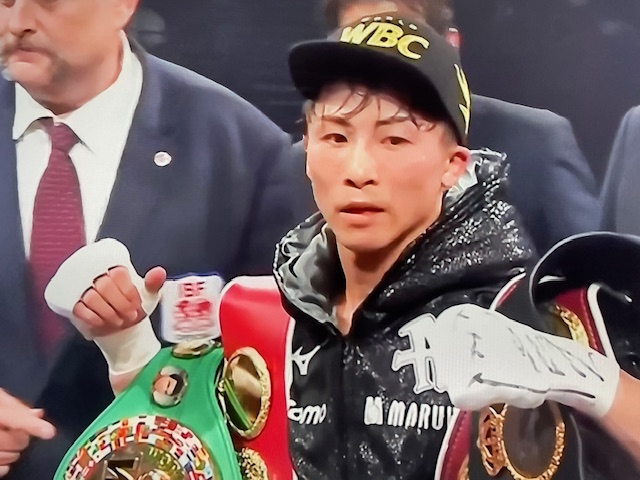
Doheny provides a benchmark to rank a potential Inoue match should the latter inevitably step up from junior-featherweight to the full 9st/126lbs division. the Japanese has already won ‘world’ titles in five different weight categories, three as an undisputed champion, and will be looking to win his sixth.

‘The Monster’ Inoue (29-0, 26 KOs) defends in Las Vegas on May 4 against American Ramon Cardenas (26-1, 14 KOs). He’s epected to be tested but come though successfully. A potential fight against Ball is mouthwatering and sure to be explosive.

Doheny (now 26-6, 20 KOs) fell to his sixth loss, the last two in bravely contesting ‘world’ titles. At 38 he’s given as much as he can in the ring at the elite level and can hold his head up high.

For Ball, at only 28, lots of options open up for him. Frank Warren’s Queensberry Promotions will be looking to maximise his profile and earning potential, whether Japan, Stateside or in Ball’s beloved home of Liverpool.