
Collectors
The gloves that Floyd Mayweather wore when he beat Manny Pacquiao are among the most desired collectables in sport.
But they are already unaffordable, and will be for many years, to all but a few extremely wealthy collectors.
Boxing fanatics all over the world rushed to obtain T-shirts, miniature gloves and other items that were produced and sold before and after the welterweight title bout in May 2015 in Las Vegas.
The memorabilia contributed to the staggering revenue generated by “the fight of the century” but their value will probably not increase substantially over the next few years.
However, the shorts, the boots and the gloves the boxers wore will be worth a fortune as long as boxing remains a popular sport that triggers hard-to-explain emotions and passion.
Gloves and clothing that Muhammad Ali, Rocky Marciano and other famous champions wore for some of the most memorable fights in history are now worth as much as coveted baseball and soccer items, if not more.
Among the most passionate boxing enthusiasts are collectors who usually regard it as a hobby, but to whom it can become an obsession.
Many South Africans own and treasure autographs, signed photographs, old books, gloves and items of clothing that their heroes wore in the ring. But only a few became long-time collectors of note.
One of the earliest serious collectors of boxing memorabilia in South Africa was Charles Zastron, a tram driver from Malvern in Johannesburg.
Not much is known about the whereabouts of whatever he had in his humble home but it was said to be of substantial value.
The Chris Lessing Museum
Chris Lessing, a Johannesburg advocate, had a collection that visitors from abroad described as one of the most complete in the world.
Lessing kept his items at his house in Alberton and after his death in 1978 everything was donated to the SA Boxing Board of Control for the establishment of the Chris Lessing Museum.
The museum was set up in the board’s offices in the Fattis and Monis building in Loveday Street, Johannesburg.
When the board moved to Nasrec, south of Johannesburg, Lessing’s collection could be viewed there, but since the move to the present offices in Midrand the items have reputedly been kept in storage.
After Lessing’s death, Helgard Muller of Pietersburg became South Africa’s leading collector of boxing memorabilia. His library of 16mm films of historic fights, international and South African, was regarded as the most comprehensive in the country.
Most SA collectors tend to specialise but others spread their wings and acquire a wide range of items; almost anything relating to boxing. Houlton Andrew, who lived at Sabie in Mpumalanga before he emigrated to England, was one of those who had an amazing range of collectables.
Chris Greyvensteyn
Chris Greyvenstein, who wrote The Fighters, a collectable book in itself, and Karel de Vries, collected mostly historical items. Both lived in Cape Town.
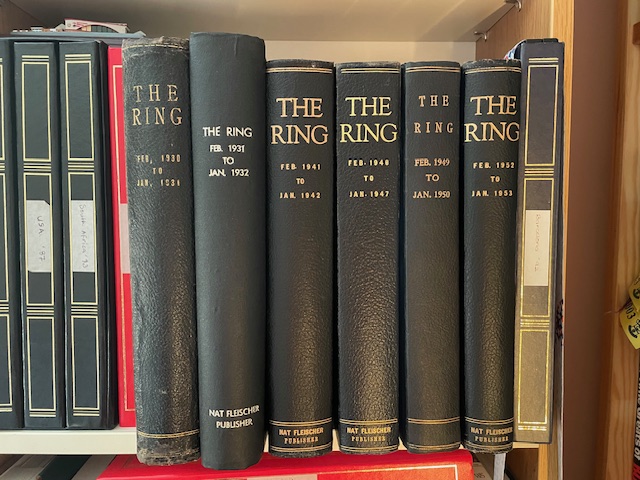
De Vries, for instance, had a complete collection of copies of Ring magazine, dating back to February 1922. At the time, Muller was the only other South African who had a complete set of the magazine’s issues.
After Greyvenstein and De Vries had passed away, their collections were sold for well below their value because there were so few avid local collectors with the money and space to take over everything and it would have cost too much to send the items overseas.
In the late 1980s Alfie Andrade established a collectors’ club in Cape Town. Meetings were well attended for a few years but the interested waned until the club ceased to exist.
Danny de Villiers, a professional referee who also lived in Cape Town, was another with an excellent collection that was eventually sold.
Jeff Ellis And Andre De Vries
Eric Moolman, in his time one of the leading SA referees, owned one of the finest collections of boxing photographs in the world.
When he was a youngster, Moolman wrote to boxers all over the world, asking for their autographs and photos. He later sold his books and photographs to Jeff Ellis, a well-known promoter who is now one of the few serious boxing collectors in South Africa.
Another one is Andre de Vries from Pretoria. He also specialises in keeping records of SA boxers and has thousands of entries in his files.
Ellis, who has a particular interest in tournament programmes, also has more than 40 000 photographs in his collection.
I have collected hundreds of boxing books since 1947 when I received one shilling as pocket money per week.
At that time, Butch Burman’s Book Store at 12 Wanderers Street in Johannesburg, advertised a copy of Joe Louis – A Picture Story of his Life. It was written by Neil Scott and cost seven shillings and six pence; which came to 75 cents.
I went without sweets for about ten weeks and also did not buy the magazine Champion during that time to save enough money to take a train from Germiston to Johannesburg and to buy the book.
After a long chat with Burman, who became a friendly and efficient supplier of books to me for many years, I went home, little knowing that collecting boxing books and other items to do with the sport would become a lifelong passion.
Beyond The Reach
Many collectors of sports memorabilia run out of space at some time or another but in recent years, as a result of the drop in the rand’s value, the cost of acquiring items from abroad has become the main constraint for South Africans.
A bound volume of Ring magazines of the 1920s and 1930s would be beyond the reach of the average SA collector, stretching to tens of thousands of rand.
A bound volume of Boxing, now known as Boxing News, comprising the first 16 issues of the English publication and covering the period from September 11 1909 to December 24 1909, was advertised for $6 000, more than R75 700 at recent rates.
One of the scarcest boxing books, Black Prince Peter, by A G Hales published in 1910 and was sold for $2 995, which now converts to nearly R38 000.Relief to Royalty – James J Braddock, a book by Ludwig Shabazian, was offered for $320 (over R4 000).
 The Undisputed