
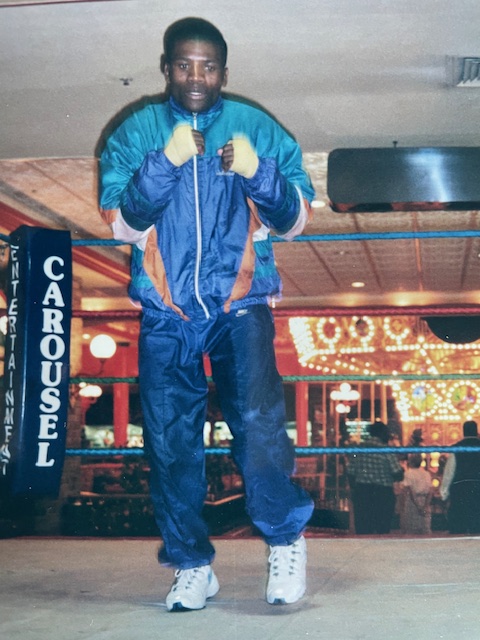
There’s no doubt to esteemed boxing writer Ron Jackson that former world class South African junior-featherweight Vuyani Bungu (39-6, 19 KOs) deserves to be in the International Boxing Hall of Fame (IBHoF), at Canastota, upstate New York, USA.
In support of this Ron points out:-
Bungu, the former IBF ‘world’ champion, domestically won more King Korn/Boxing World awards than any other South African fighter. He was voted their Boxer of the Year in 1994, 1996, 1997 and 1998.
His fights against Jesus Salud and Kennedy McKinney were also named their Fight of the Year in 1996 and 1997. He subsequently received a Special Award in 1995.
Overall, his backstory, record and achievements were outstanding ones.
Only two South Africans, referee Stan Christodoulou and two-belt ‘world’ champion Brian Mitchell, are currently inducted into the IBHoF. Bungu deserves to be the third.
Bungu’s story
This brilliant fighter was born in Duncan Village near East London in South Arica’s Eastern Cape, at the foot of the continent, on February 26, 1967.
His family moved to Mdantsane shortly afterwards, where many residents came to know him as “The Beast” and where he developed into one of the best boxers to come out of South Africa.
It is not clear why he was nicknamed “The Beast” because he never fought like a beast and never acted like one outside the ring.
One of six children who grew up poor, little Vuyani sometimes went to school without anything to eat.
During an interview on the SA SuperSport programme Punchline he told how he would take a plastic bag with a stone inside to school, where he would turn his back on his friends and pretend to eat bread from the bag.
His father suffered from asthma and his mother, Lilian, who was employed as a domestic hand, just managed to keep the family of eight alive in their two-roomed house, without water or electricity.
Vuyani learnt to box in a gymnasium at school in Mdantsane. There was only one punch bag, but his loyal trainer was Mzimasi Mnguni.
Mnguni was his manager and trainer throughout his career. He bought Bungu his first suit and gave him money to buy food for his family.
Their relationship seemed to turn sour about 20 years later when it was reported that Bungu, who had allegedly earned more than R10 million (Rand) between 1994 and 2005, was broke.
He reportedly denied that he had made so much money and blamed the taxman and Mnguni for his financial problems.
It was claimed that Bungu sometimes fought without signing contracts and not knowing how much he would be paid. But it was also reported that he lived lavishly.
After building up an impressive amateur record of 77 wins against 8 losses (some reports said he won 108 and lost 20) Bungu made his professional debut on April 26, 1967. He knocked out Xolela Makhuluma in the fourth round in Mdantsane and was paid R34.
He had left the Nyameko High School in the ninth grade to pursue his boxing career.
After winning four of his next five fights inside the distance, Bungu won the Cape Province junior featherweight title when he outpointed Sexon Ngqayimbana over ten rounds in June 1988.
He won his next six fights, including five defences of the Cape title, before suffering his first defeat. It came in August 1989 when he challenged hard-hitting Fransie Badenhorst for the SA featherweight title in Cape Town.
Bungu was knocked down three times but fought back. Badenhorst was bleeding and down in the seventh round. However, Bungu did not keep up the pressure and it cost him the fight.
In a return fight in East London in May 1990, Bungu was a clear winner and became the SA junior featherweight champion.
Marching towards the IBF title
He made five successful defences and received an Old Buck (national) belt before relinquishing the title when he won IBF junior featherweight belt.
On his way to the title, he stumbled only once. It happened in April 1992 when he fought American southpaw Freddie Norwood in Trievelo, Italy. Norwood, undefeated after 15 bouts, outpointed the South African over eight rounds.
Bungu won his next four fights inside the distance before challenging highly rated American Kennedy McKinney for the IBF junior featherweight belt. They met at the Carousel Casino at Hammanskraal, near Pretoria, on August 20, 1994.
McKinney was an outstanding amateur who won the bantamweight gold medal at the 1988 Olympic Games in Seoul. He won the IBF belt from South African Welcome Ncita and made five successful defences.
The American, rated as one of the best fighters in the world pound-for-pound, was comprehensively outpointed by the unheralded Bungu, who produced one of the finest performances in a world title fight by a South African.
Roller-coaster ride
The bout started a roller-coaster ride for the new champion, who made 13 defences of the belt. This was a record by a South African, eclipsing the one he had shared with Brian Mitchell.
However, there were good and bad performances during that time. In his fist defence, against US-based Puerto Rican Felix Camacho, Bungu had problems with his opponent’s southpaw style but won easy enough.
In 1995, he retained the belt by beating Mohamed Nurhuda (Indonesia), Victor Llerena (Colombia) and Laureano Ramirez (Dominican Republic), all on points.
The next year he beat American John Lewis in Biloxi, Mississippi, before returning to his favourite venue at Hammanskraal to stop Colombian Pablo Osuna in the twelfth round and outpointing Jesus Salud from the Philippines.
In April 1997, in a return match with Kennedy McKinney, Bungu won by split decision in a 12-rounder that the McKinney camp thought their man had won.
Bungu had two more fights in 1997, beating Enrique Jupiter from Mexico and Arnel Barotillo from the Philippines on points.
On May 16 the next year, back at the Carousel, Bungu was below his best when he beat Colombian challenger Ernesto Grey on another split decision.
Back to his best in Atlantic City
Bungu was back to his best in October 1998 when he defeated former IBF flyweight and junior bantamweight champion Danny Romero in Atlantic City, New Jersey, USA. In retaining his belt for the twelfth time, he proved he was the best junior featherweight in the world.
Bungu was given less than a 50-50 chance of beating Romero, but after his fine performance there was talk of him facing ‘Prince’ Naseem Hamed for the WBO ‘world’ featherweight belt.
However, Bungu first had to defend his IBF title against the mandatory challenger, Victor Llerena from Colombia.
On a memorable night, February 6, 1999, Bungu retained the belt for a record 13th time when Llerena failed to come out for the eighth round after taking a pounding from the champion.
The fight against Naseem
After the fight it was announced that Bungu was relinquishing the IBF title to challenge Hamed.
It took more than a year to finalise the bout. Bungu remained inactive before travelling to London to face Naseem on March 11, 2000.
The fight, regarded as one of the biggest in the history of SA boxing, was arranged by Rodney Berman’s Golden Gloves group, with Berman at the head of the contracted negotiations.
However, Bungu was never in the fight, attended by 10,000 spectators. His dream was shattered in 13 minutes and 38 seconds when he was knocked out in the fourth round.
The Bungu who fought Naseem was not the fighter his admirers knew.
Ron Jackson was with Bungu in London at the time and, travelling in the bus with him from his apartment in Lancaster Gate, it was clear to Jackson that the occasion was too big for him. Bungu began unravelling long before he entered the ring.
Hamed; as was his style, made a magnificent entrance into the arena, coming in on a flying carpet and somersaulting over the ropes. He even took the microphone from famed ring announcer Michael Buffer to address the crowd before the bell.
Bungu’s helpers shielded their man from his opponent. Ron felt he should have stood in the centre of the ring and eyeballed his opponent as he had done at the pre-fight press conference and at the weigh-in.
Fading from the scene
Bungu soon began fading from the scene, but did not officially announce his retirement.
About 16 months later, he returned to fight fellow-South African Lehlohonolo Ledwaba for the vacant WBU featherweight belt, but was well beaten over 12 rounds.
After an absence of ten months, on May 31, 2003, Bungu beat Takalani Ndlovu over ten rounds in an eliminator for an IBO featherweight title fight.
In a return match, in February the next year, they fought for the vacant title. Bungu beat Ndlovu on split decision to become a two-time “world” champion.
On June 25, 2005 he put up a brave performance against Thomas Mashaba but lost on points over 12 rounds to lose his IBO belt.
This was to be his last fight. He retired with a record of 39 wins and 6 losses, winning 19 bouts inside the distance. His story was a real fight from humble beginnings to the pinnacle of his sport. It should be celebrated and his achievements recognised further.
 The Undisputed